
Ritwika Roy
Kolkata, or Calcutta as it was once known, is replete with stories of ghosts and hauntings, many of which stem from the city’s days as the capital of British India. There’s the National Library, where former Governor-General Lord Hastings is rumoured to appear in the dead of the night, riding his phaeton.

Barely 5 kilometres away is Putul Bari, or the House of Dolls, the second floor of which is said to be haunted by the victims of zamindari ruthlessness and therefore, unapproachable. Writer’s Building, which till 2013 was the seat of the Government of West Bengal, is reportedly inhabited by the ghosts of officers and clerks from the British Indian Government. Stories swirl at Loreto House, a girl’s school for nearly 200 years, but once the garden house of Lord Henry Vansittart, Governor of Bengal from 1760 – 64, of ghostly nuns in the church steeple at St. Thomas’ Church, and South Park Street Cemetery has long been famous for its spooks. Ghostly horses still run in the Race Course and Nimtala Burning Ghat still braves the restless spirits of the cremated. This is not including the various bhoots which populate the folklores of Bengal – the bramhodoitos, the meccho bhoots, the skanddhokatas, the shakchunnis, and petnis, among others that we have previously written about here at ACLiSA.
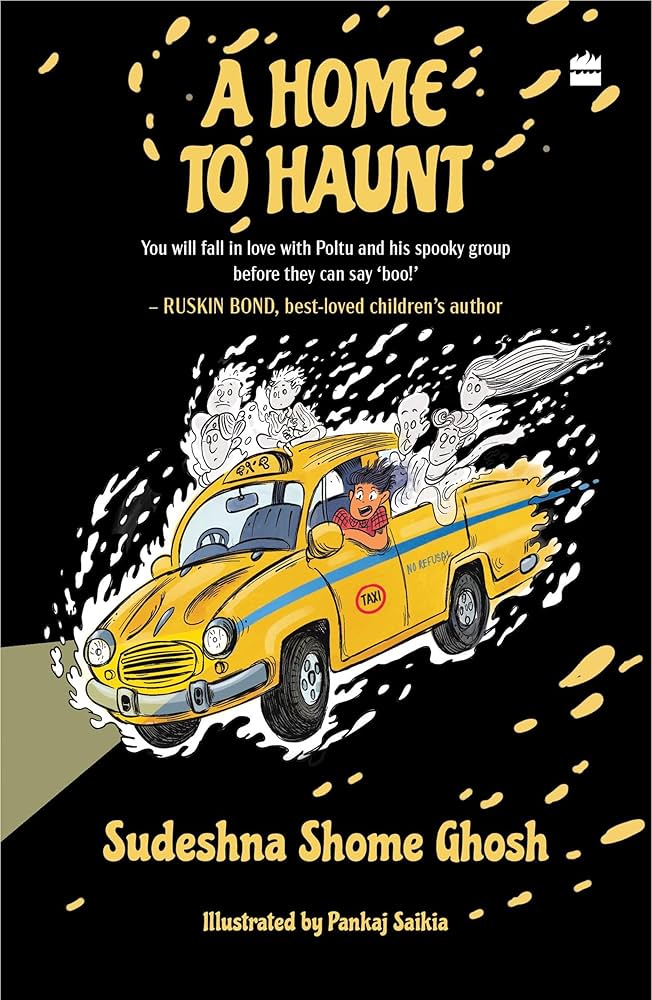
Sudeshna Shome Ghosh, in moving from the editorial desk at Talking Cub to the authorial at HarperCollins, has taken these various ghost varieties of Bengal in her debut middle-grade novel A Home To Haunt, and has given them a new dress clothed in her own nostalgia for the iconic landmarks, spaces and objects of Kolkata. The book is illustrated by Pankaj Saikia, who adroitly translates Shome Ghosh’s vision to pictures in a style reminiscent of both Quentin Blake and Bengali comics.

The ghosts are just blurry enough and the yellow taxi, an icon of Kolkata’s streets, is just yellow enough. And just as yellow Ambassador taxis are a personality onto themselves, a heritage speaking of quieter times in Calcutta thoroughfares with less traffic and flyovers, Shome Ghosh’s yellow taxi, which drives her young Master Poltu Sen and his band of ghosts around the city, does not hesitate to make its presence known.
Master Palash Ranjan Sen, better known as Poltu, is 8.5 years old and on his way to his maternal grandparent’s place in Siliguri for the summer, where he is going with his Mama (mother’s brother). At Sealdah Station, another Kolkata icon, he discovers that his Mama moonlights as a Ghost Traffic Warden, and on this particularly busy night with many a lost ghost, he must embark on his first adventure as a junior warden and find these lost ghosts their homes in the city.

Poltu and his trusty taxi take a night ride across the city and visit several landmarks in central Kolkata, from South Park Street Cemetery with its British ghosts to Eden Gardens where the cricket crazy ghosts reside to Howrah Station, and of course, Sealdah Station. Poltu meets many kinds of ghosts because ethnicity has no bearing on what kind of ghost you’ll become once dead of course, as viewers and lovers of the Bengali film Bhooter Bhabisyat (2012) know. British sahebs and Bengali babus are all ghosts at the end of the day – the question is if they can cohabit peacefully, which Shome Ghosh seems to think is possible if they can bond over food and cricket, as Poltu learns. The readers share Poltu’s anxiety about whether he’ll be able to successfully rehome the ghosts before the sun rises and tragedy strikes.
The nostalgia for the city lives beside child-like curiosity and joy, which is gleefully embodied in the form of Cadbury’s Gems in all their colours, though the ghosts only eat the red ones. As a novel, the narrative embraces Kolkata’s colonial history and comments on how contemporary Bengali culture has also been directly impacted by it, as it familiarises its young readers with the city’s history and geography. Shome Ghosh’s prose brings history alive in the quiet of city’s nighttime when the Maidan is drenched in darkness and traffic is minimal, and her own joy is evident in her writing. As is her love for the city she spent her own childhood in. Perhaps in the sequel, Poltu can traverse down Park Street and partake of a glittering ghostly high tea at Flury’s.

Author Bio

Ritwika Roy is one of the co-founders of ACLiSA. She is trying to complete her PhD on Indian English children’s and YA lit at Jadavpur University but is too distracted by K-drama.
