
Interviewed by Anurima Chanda
My initial interaction with Pankaj Saikia took place in the scenic town of Pathshala, on a serene winter morning bathed in the warm glow of the sun. Pankaj exuded the same warmth akin to the winter sun, as he shared his experience ideating for The Theatre of Ghosts and graciously responded to my inquiries about his creative process. It was clear from our conversation how deeply passionate he was about illustrating children’s books, and we embarked into an enriching discussion about the trials and rewards of being a children’s author and illustrator in India. In this interview, I have had the privilege of delving deeper into his creative vision and exploring the inspirations that fuel his artistic pursuits. Join me as I embark on a captivating dialogue with Pankaj Saikia, where he generously shares his reflections and perspectives on the world of children’s literature and illustration.

1. Can you tell us about your journey into the world of children’s illustration? What sparked your interest in this particular genre? And, is this your full-time profession?
Ans: I have always been interested in visual story-telling, primarily because of an early exposure to comics. I always knew that I wanted to draw comics. However, I never was conscious regarding writing or drawing for a particular age group. It was only much later in my first job as an illustrator where I was required to produce material for school kids that I became more aware of the age group of the readers.
My second proper job as an illustrator involved creating artworks for school textbooks for kids in Sikkim. Following these experiences, my artwork kind of evolved into children specific genre, where I was exploring themes with children as central characters. When the art director of Pratham books, Canato Jimo, saw my work on Instagram, he approached me to illustrate a picture book for them. Since then, I have illustrated more than 15 picture books for varied publishers and authored and illustrated two books.
Currently, majority of my projects involve designing visuals for school textbooks. Only a portion of my work, around 40 percent involves picture book projects. I also do animation and branding projects along with art workshops.
2. Which artists, writers, or mentors have shaped your artistic growth? If you could have dinner with three of them, who would they be?
Ans: The team at Pratham books have been pivotal in my growth as a children’s book illustrator. The experience of working with them through my first picture books helped build the perspective and further my understanding of picture books as a medium.
As inspirations, I have always looked upon the works of Hayao Miyazaki, the Japanese animation filmmaker. The works of another filmmaker, namely Isao Takahata, has had a huge influence on my work. Apart from them, I am much inspired by the works of artist/illustrator Dave McKean, Quentin Blake and Marjane Satrapi.
If asked to have dinner, I would love to sit down and discuss art with Hayao Miyazaki, Isao Takahata (sadly he passed away recently) and Neil Gaiman.
3. How would you describe your artistic style? Are there any particular themes or motifs that you often explore in your illustrations?
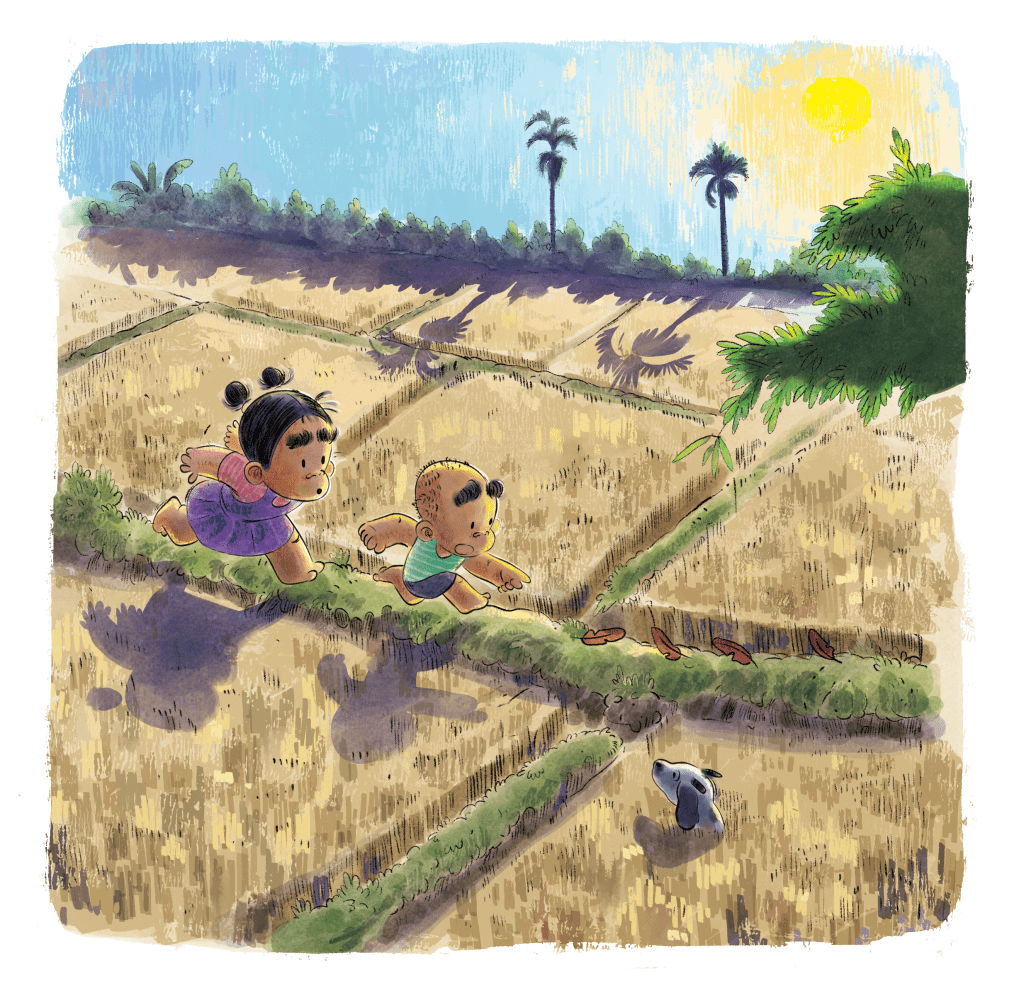
Ans: My artistic style has a heavy influence of the works of Studio Ghibli, primarily because I find a lot of similarity in their representation of landscape and my local surroundings in Assam. Initially I drew heavily from the visual styles of the films of Isao Takahata (Only Yesterday, Princess Kaguya). However, more recently, my style has begun to shift from a more water-coloury look towards a more rustic style of drawing. I am more interested in producing visuals that do not adhere to a particular norm, rather appeal to the demand of the particular project I am working on.
With regards to themes, I am interested in drawing visuals that represent the socio-cultural details of the region I am from. I also love drawing about nature. I believe my storytelling is heavily derived from my region, however, at the same time I try to find ethos that are more universal within the local elements itself.
4. What mediums and techniques do you prefer to work with when creating illustrations for children’s books?
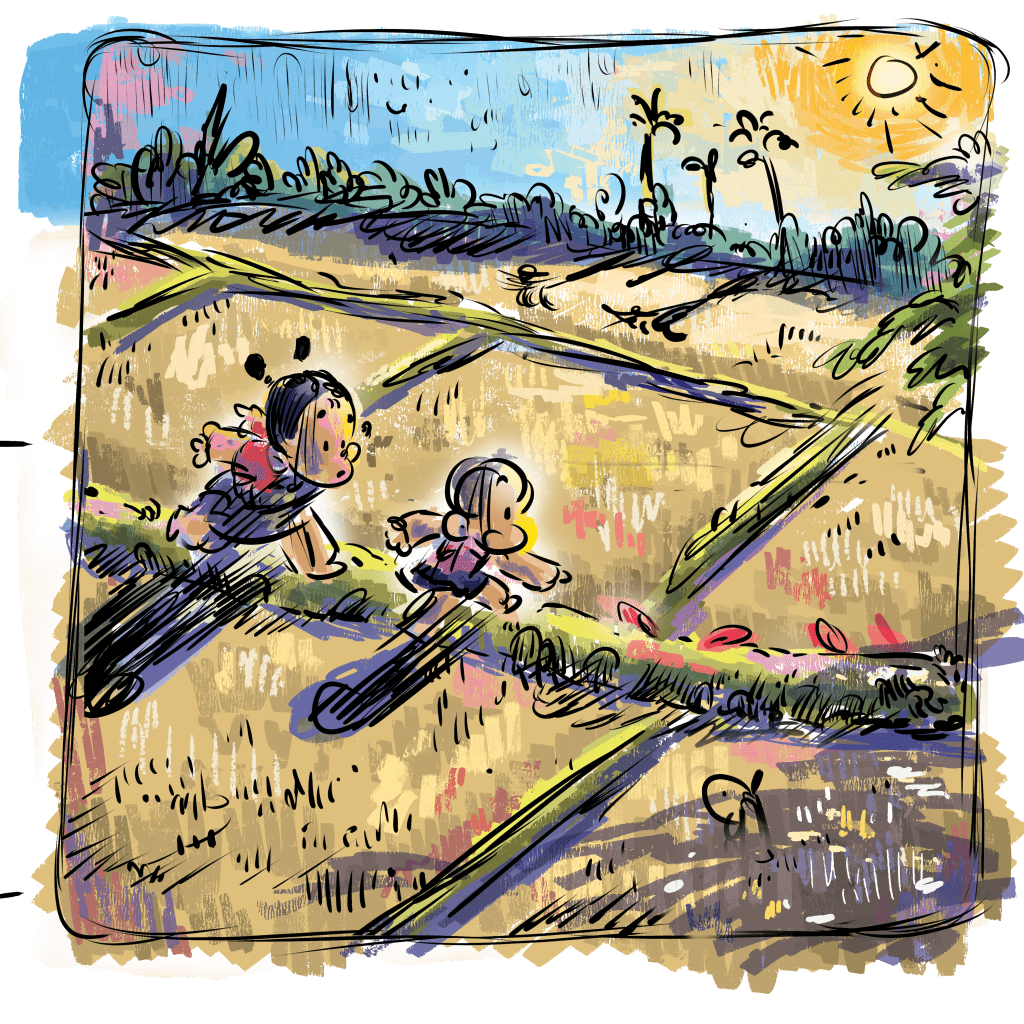
Ans: I love drawing on paper and I love the feel of ink on paper. So, I try to incorporate some amount of traditional elements into all my artworks. My process, if time permits, is often a mix of traditional and digital medium. I love producing line drawings traditionally as that gives me more control over the quality and nature of lining. However, in case of colouring, I prefer to do it digitally as it allows me to produce the artwork within a stipulated amount of time that I usually get for picture book projects. Colouring digitally also gives me greater freedom in terms of corrections and revisions, which can be a difficult process if done solely traditionally.
5. Where do you draw inspiration from when developing characters and scenes for children’s stories?
Ans: I try to base my characters on real people. Mostly children I have met, my cousins, siblings, my friends. That way I am able to feel the characters more while drawing and bring more personality to them.
6. Could you walk us through your creative process, from conceptualisation to final illustration? How do you approach a new project?
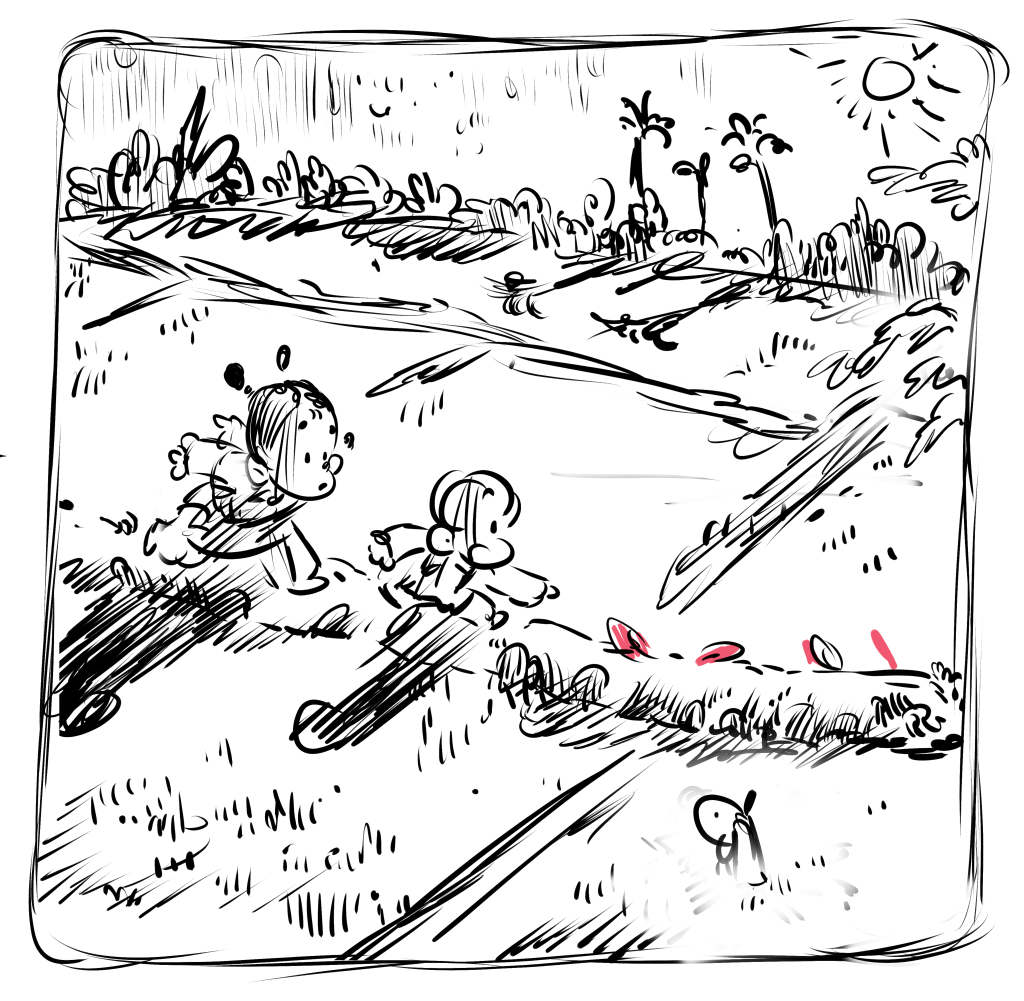
Ans: In cases of projects where I am hired as an illustrator, it mostly starts with character design, followed by rough storyboards. Once the storyboards are finalised, I go on to producing the final illustrations. Most time is spent on the storyboards as that is what determines the flow, structure, and compositions.
As for projects wherein I am both the author and illustrator, whether picture books or comics, it mostly starts with numerous doodles of characters. This is usually followed my numerous rounds of storyboards which may also include texts depending on the nature of the story. It is only after I have finalised everything in the storyboard phase, I go on to produce style frames that would determine the look and feel of the story. Character development and designs may happen simultaneously at this stage. The final artwork then is mostly about maintaining consistency in style throughout the book.
7. How many books have you illustrated so far? Do you lean towards a specific genre when accepting illustration commissions, such as fantasy, realism, or narratives centered around emotional themes?
Ans: I have illustrated over 15 books so far, 10 of which are available on print and the rest are at various stages of publication process, soon to be out in print.
Although as a genre I lean more towards slice of life, humour, and fantasy, stories with food as a theme excite me as well. However, as a children’s book illustrator working in the Indian context, we do not get much choices to make. As both publishers and the market are limited, we do not get to see a variety of experiments in genre.
8. Can you share any memorable experiences or challenges you have encountered while working as a children’s illustrator?
Ans: Oh yes. There are plenty. Every time I get an opportunity to interact with kids regarding my book has been a surprising event. The reactions and interpretations that they come up with is something that I always look forward to.
One of the recent challenges I faced was in a graphic novel project set in Assam. As the writer was not from Assam, the project relied on my experiences of the region to correctly depict the socio-cultural backgrounds. While going through the script we actually ended up changing the characters to a great extent which was a major challenge and impacted the story both visually and in terms of narrative. A major challenge was in representing one of the characters who was a girl that belonged to the ragpicker community. To be able to represent a profession with dignity without whitewashing the harsh realities is a difficult task. It was also a challenge to correctly depict communities that I have little experience interacting with. It was one of the projects that made me realise how picture books and graphic novels are always a collaborative process. A lot of minds including the writers, editors, art directors, and illustrators go into making a good picture book.
9. In your opinion, what makes a children’s book illustration truly impactful and engaging for young readers?
Ans: The fact that picture books are a combination of visual medium and text makes it a powerful tool of communication. They work extremely well in cases of kids who are beginning to read or have got some practice with reading longer sentences. In other words, picture books in many cases are a bridge between the young readers and the readers of tomorrow.
However, the role is not limited to acting as a bridge alone. As a medium they are powerful tools in talking about complex topics in simplest forms. The act of both “reading” and “looking” at a picture book has an empowering effect on the reader.

10. How do you ensure cultural sensitivity and inclusivity in your illustrations, particularly considering the diverse audience of children’s literature?
Ans: As an illustrator working in the children’s book medium, it is my responsibility to present visual with cultural sensitivity and inclusivity.
While working as an illustrator helping to design textbooks for the Sikkim government, the design team was taken on educational excursions throughout Sikkim prior to beginning the project. The idea was to help immerse the team in the culture and traditions of the various communities. Special care was taken to sensitise us towards the various communities living in Sikkim. This enabled us to create illustrations and designs that would achieve a healthy and balanced representation of all the communities.
Similar approach also went into representing skin tones of the characters; the idea being that since our readers are from various socio-cultural and economic backgrounds, they must also interact with visuals wherein they are able to see themselves.
11. Are there any specific cultural or regional influences that you incorporate into your illustrations, being an illustrator from India?
Ans: I try to incorporate my local culture wherever possible. That being said, being an illustrator can be really fun when you have to explore cultures other than your own. This not only involves a lot of research but also requires a deep understanding of the feelings associated with the visual material of that particular culture.
Although I always say yes to an opportunity to illustrate more about Assam, I do love projects that are completely alien to my own culture. That is one of the reasons I love doing fantasy illustrations where you get the unique opportunity to synthesise various cultural elements.
In a project, I try to be truthful to the story and characters and try to represent the characters and their surroundings within the culture that it is set in.
12. What advice would you give to aspiring children’s illustrators, especially those from India or other diverse backgrounds, who are looking to break into the industry?
Ans: If you are aiming to be a children’s book illustrator In India, the best way to do it would be to tell stories from your own surroundings. The variety that India as a country offers both visually and in terms of stories is immense, and there is much more to explore locally.
However, as a full-time picture book illustrator, I must say that it is a difficult profession. Despite being a huge country we lack the required levels of funding that would help create book projects wherein you are able to invest long durations of time. Book projects in India are immensely under-paid which necessarily means you will have to be able to juggle between multiple projects at the same time.
One must necessarily learn to deliver on strict deadlines while maintaining the quality of artworks. Having said that, the good news is that our economy allows other opportunities for illustrators as well. There are lot of other sources of income that an illustrator can fall back on, such as animation, branding, merchandise, teaching, etc. Another avenue would be to not limit your clientele within the country itself, but try to work with international publications as well. With that being noted, all of it boils down to investing good amount of time in honing your skills and understanding the kind of illustrator you want to be and the kind of stories you want to tell.
It can be an extremely rewarding and satisfying profession. The level of satisfaction that I get after completing a book and sharing it with kids is immense.
