
Divya Choudary
“And then what happened?” my mother would prompt.
“Matsya outgrew the lake!” we’d reply, our voices filled with joy.
My sister and I loved hearing stories, especially the way our mother animated them at bedtime or during those cherished moments under the stars when the power would go out. We grew up with a wealth of Konkani folktales: Punyakoti, the cow of integrity; Gupchaka, the clever sparrow who outsmarts a greedy crow; and Mohini and Bhasmasur, where a young girl cunningly defeats a demon to save her village. The story of Matsya was special—a tale passed from my great-grandaunt to my grandmother and then to my mother. Each retelling added a layer of depth, with voices shifting between languages, sometimes slipping into Konkani. Matsya felt like it belonged to us, both timeless and uniquely ours.
Matsya, the Magic Fish: Childhood Fantasies and First Impressions
At five years old, the story of Matsya was pure magic. A rainbow-coloured fish that kept outgrowing every container it was placed in? A talking fish with the power to save its family? My sister and I, both avid swimmers, would listen, wide-eyed, imagining ourselves swimming alongside Matsya. For us, Matsya embodied ideas of home, kindness, and the love that binds family.
Years later, Shantakka, my great-grandaunt, gifted us books she’d written—The Tales of Ancient India, The Mahabharata, and several short stories, including Matsya. The story of the magic fish began to take on a new dimension.
Fantasy as a Vessel for Wisdom: Matsya’s Spiritual and Cultural Symbolism
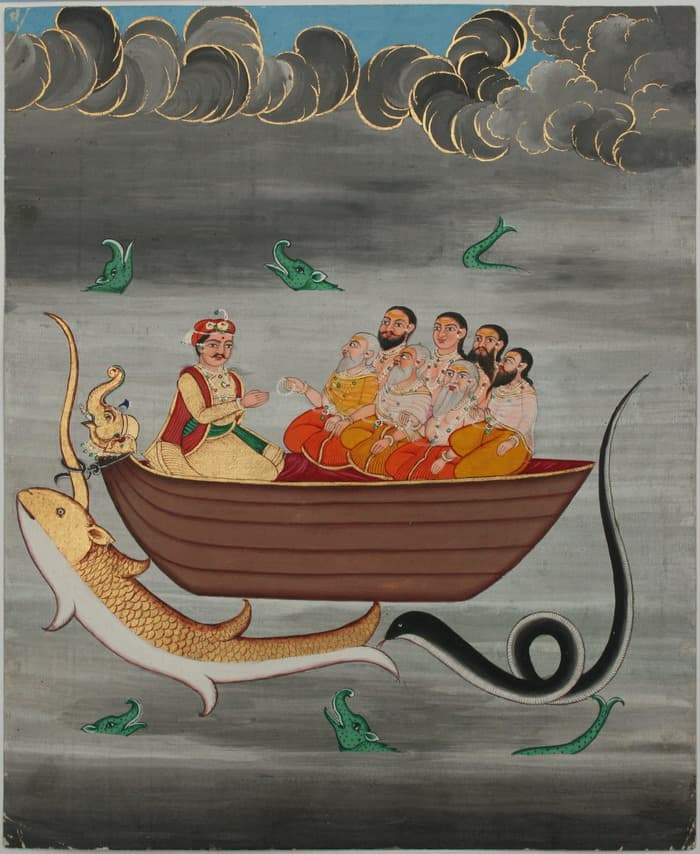
As a teenager, Matsya’s story resonated in new ways. I learned that Matsya appears in the Shatapatha Brahmana and the Mahabharata as a tale of divine intervention, cosmic order, and resilience in the face of catastrophe. In the Mahabharata, Matsya is Vishnu’s fish avatar, who warns Manu, the first man, of an impending flood meant to wash away life on earth. Matsya instructs Manu to build a boat to preserve the seeds of life and the knowledge of humanity. Having learned about similar flood myths in The Epic of Gilgamesh and Noah’s Ark, I saw connections that hadn’t been apparent to me as a child.
Through this lens, I understood why Matsya kept growing: its growth represented expanding wisdom and the protective power of divine guidance. Fantasy here was layered with cultural meaning and spiritual symbolism, using myth to explore universal themes of survival, transformation, and the preservation of knowledge.
From Fantasy to Legacy: Matsya’s Journey through Memory and Myth
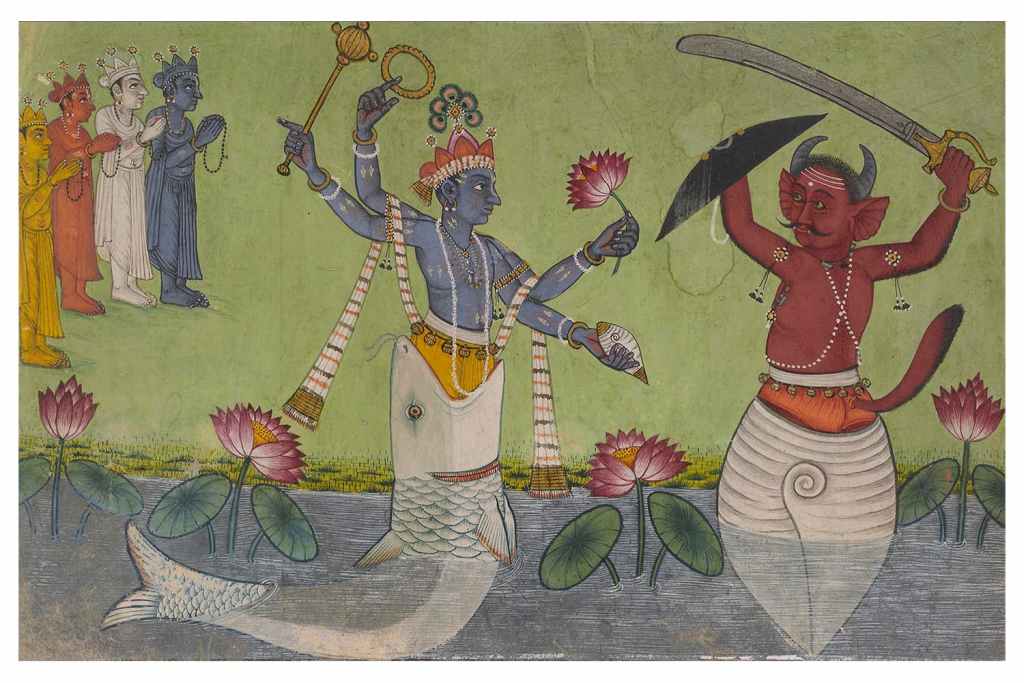
South Asian tales often weave fantasy with moral insight, and Matsya is no exception. Reflecting on Matsya’s story, I am reminded of how it embodies universal needs for security, growth, and order amid chaos. These stories are more than mere tales; they are lessons veiled in magic, fostering courage, kindness, and curiosity.
The story of Matsya, once a childhood bedtime favorite and later a profound myth, showcases the richness of South Asian oral traditions. Family narratives often straddle simplicity and profundity, evolving as we mature. What began as a bedtime story became a tale of faith and resilience—a bridge between memory and meaning that continues to inspire.
Revisiting Matsya before writing this essay has reaffirmed my appreciation for family storytelling. Stories shared across generations carry more than history; they embody timeless wisdom, offering themselves for rediscovery at each stage of life. Fantasy, then, is not merely an escape but a means of understanding and connecting with our world. By revisiting these ancient myths and adapting them, we keep our heritage alive, ensuring it remains a vital part of children’s literature today.
Author Bio
Divya Choudary works with narrative and design in edtech, drawing on her background in print and new media as well as children’s literature and literacies. She enjoys exploring storyworlds across books and various media—always with a cup of tea in hand. She can be reached at dchoudary@gmail.com.
