
Rhea Kuthoore
My journey with Philosophy began during my undergraduate years. By 2019, after completing my degree, I found myself thinking more critically about how a philosophical education can be transformative. It was this line of questioning that led me to engage with and practise philosophy with children in India, in order to explore what it might mean to bring philosophical inquiry into school contexts.
This exploration took concrete form at Sholai School in Tamil Nadu, where I worked for two years. During this time, I had the freedom to design and teach ‘philosophical explorations’ for students aged 8 to 16. However, I soon realised that there was a significant lack of awareness and resources to support the practice of philosophy with children in India. To overcome this, I sought guidance from mentors outside of India and worked to adapt existing resources to our context. At that time, there were very few educators in India engaged in this field. Fast forward seven years, the community has grown significantly. There are now several passionate individuals in India who contribute to this field, including through the forum childrendoingphilosophy.org.
In the meantime, I have continued to deepen my own engagement with this work over the past six years. I have completed a Master’s degree in Childhood Studies from Rutgers University. Most recently, I completed a fellowship at the International Youth Library in Munich. During this fellowship, I identified picture books and stories suitable for philosophical exploration that have not yet been reviewed by major organisations in this field, including PLATO, Prindle, and IAPC.
Philosophy with children is a global educational movement to acknowledge and nurture children’s philosophical selves — the parts of them that wonder and seek answers to the contested and perennial questions of life like why should I share? How much freedom can I have? Why do we follow rules? — questions that are also considered to be central to our lived experiences. This movement emerged from educators’ efforts to acknowledge that children ask philosophical questions from a young age. When encouraged, they are fully capable of exploring these questions, offering their perspectives, and reflecting on their experiences and thoughts. The goal is not to teach young people philosophical theories but to engage them in thinking philosophically together, thereby learning how to philosophise.
The process occurs within a community of philosophical inquiry, where facilitators engage in humble questioning alongside participants to guide dialogue. In class, we use a stimulus, prompt, or provocation—essentially real-world challenges, such as ethical dilemmas, that encourage philosophical thinking. The stimulus should be relevant to the lived experiences of young people and avoid being overly abstract. It is even more effective if it incorporates thinking techniques that constitute philosophical thinking, such as, reasoning, hypothesising, spotting assumptions, assessing implications, etc.
There are numerous benefits to practicing philosophy with children: the inquiry process fosters the creation of knowledge rather than mere consumption, supports both emotional and intellectual growth, transforms classroom dynamics, and challenges the adult-centric nature of philosophy.
Here, when I use the term ‘philosophy’, I am referring to a mode of inquiry rather than a body of canonical texts. I understand the ‘philosophical’ as a method of thinking, feeling, and reflecting on questions that cannot be answered solely through existing methods such as empirical evidence, observation, mathematics, or science and that involves a yearning for deeper meaning. Philosophising requires a unique way of thinking that combines various cognitive strategies. As a result, philosophy can be found within all disciplines; for example, there is a philosophy of mathematics, a philosophy of science, a philosophy of history, and a philosophy of psychology. These branches allow us to examine the assumptions within each discipline and explore how we think within them.
In philosophy with children, we explore several types of questions. We engage with questions that allow for multiple valid perspectives, such as: What counts as punishment? What counts as consequence? Should sports be divided by gender? We also consider questions that do not have knowable answers, like: What happens after death? Additionally, we address questions that are worth rethinking, such as: Is war the solution to disputes? Finally, we tackle questions that push the boundaries of our current understanding, like: What if age were not a criterion for dividing children from adults?
When discussing picture books, I draw on scholars such as Gareth Matthews and Frances Bottenberg to understand what makes a story philosophically generative. Following Matthews, I view philosophy as an encounter with genuine perplexities or moments of uncertainty that invite reflection rather than resolution, and I argue that many children’s stories naturally contain such moments. A book becomes philosophical not simply because it addresses themes like power, justice, or good and evil, but because it actively invites readers to question assumptions, consider multiple perspectives, engage in thought experiments, or dwell in open-ended dilemmas. While thoughtful facilitation can draw philosophical depth from many texts, practitioners have observed that some stories more readily sustain collaborative inquiry than others. My work, therefore, focuses on identifying and analysing those texts that meaningfully provoke philosophising rather than merely presenting moral themes.
In my research, I do not read children’s literature against canonical philosophical texts; rather, I examine stories for their capacity to model and stimulate philosophical thinking. My focus is on how a text generates philosophising: whether it evokes genuine questions, sustains multiple perspectives, resists easy moral closure, and invites both child and adult readers into shared perplexity. Drawing on existing scholarship in the field, I identify certain recurring qualities in philosophically generative stories: they avoid dogmatism, do not portray children as adult-like philosophers, and employ narrative strategies, such as thought experiments, dilemmas, conceptual play, irony, dialectic modelling, characters and perspectival shifts that prompt readers to examine assumptions and test ideas. Alongside textual analysis, I also develop classroom approaches rooted in the stories themselves, offering ways to translate literary potential into collaborative philosophical inquiry.
In the Indian context, there remains very little systematic recognition or reviewing of picture books that meaningfully invite philosophical inquiry. My work seeks to address this gap by identifying, analysing, and disseminating children’s literature that fosters collaborative thinking and open-ended reflection. The significance of this effort lies not only in strengthening scholarship around philosophical children’s literature, but also in witnessing how young people across diverse educational settings respond with seriousness and delight when invited into genuine dialogue. In classrooms where academic outcomes often dominate, creating space for shared questioning and attentive listening can itself be transformative. Expanding this field, therefore, is not merely a literary or pedagogical project; it is an invitation to reimagine children’s literature as a site of intellectual agency and collective inquiry.
As part of my ongoing commitment to developing this field, I will be offering a ten-week online course on philosophical children’s literature, where we will explore a range of texts and pedagogical approaches to philosophising with young readers. The course draws in part on the stories I encountered, examined, and reviewed during my fellowship at the International Youth Library in Munich. In addition, a two-week exhibition in Chennai this June will create an immersive space for engaging with philosophically rich children’s literature. Those interested in learning more are warmly invited to get in touch.
About the Author:
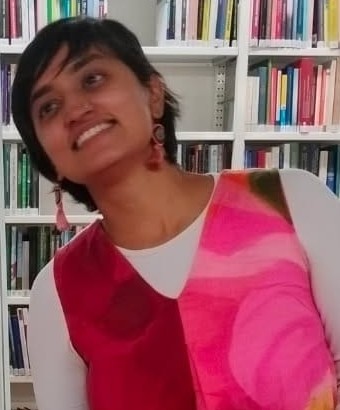
Rhea Kuthoore is an independent scholar and practitioner of philosophy with children and is advancing the educational movement in India through the collective — https://childrendoingphilosophy.org/. She offers online courses such as, https://childrendoingphilosophy.org/upcoming-courses (beginning this March), for all those who are interested in learning and contributing to the field. Additionally, Rhea is opening a dedicated space for children’s philosophical exploration in Chennai, aiming to engage a wider diversity of children and educators. In this space, she will feature 150 (and growing) of her favorite philosophical picture books from around the world which she has collected over the years. In her free time, Rhea enjoys playing tennis and going on cross-state cycling trips.
