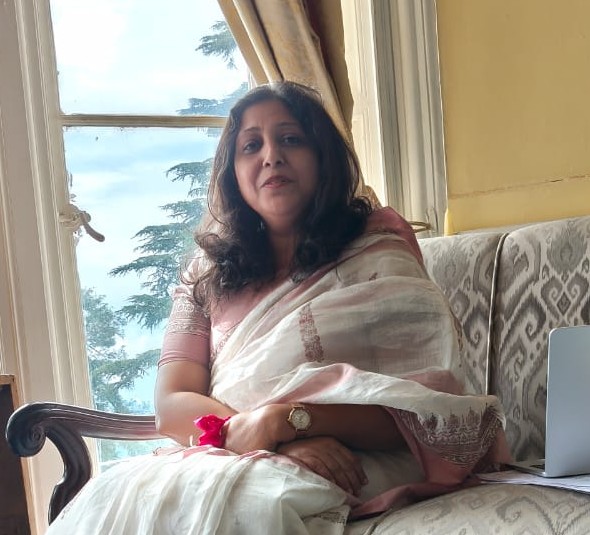
Kamayani Kumar
“Riots are an uncanny subversion of normalcy”[1]
Riots create an uncanny experience because they involve a collapse of the familiar social structures, and the world feels alienated and hostile. This is especially true in the context of children. Most often, children emerge as the most invisible victims of riots, largely because of their inadequate ability to effectively verbalise their thoughts and emotions.
This article seeks to explore how riots have affected different generations of children growing up in the Indian state of Gujarat. Children in Gujarat have suffered the misfortune of having seen 443 instances of Hindu-Muslim riots between 1970 to 2002. Yet, a deep silence encapsulates children’s experience of violence, fear, and trauma. Violence done to children has implications that are even more difficult to map. Given their relatively less developed cognitive capacities, children “find it difficult, if not impossible, to effectively communicate their emotions and have often been described as the ‘silent or invisible’ victims of disasters or traumatic events.”[2] Moreover, in the humongous task of bringing the displaced people back on their feet, children often remain marginalised. As has been pointed out by relief workers helping children from families affected by the Gujarat violence in Panchmahal District, Gujarat:
“Children are often the most invisible of the victims’ following disasters. While rehabilitation efforts focus on the provision of immediate relief and subsequent rebuilding of lives through livelihood opportunities and shelter, it is often assumed that young minds cannot fully comprehend and internalise disaster experiences. Children are, thus, left out of all efforts of disaster planning and rehabilitation, to cope with confusing, frightening experiences using their own devices.”[3]
How does one try to initiate the three Rs – rescue, relief, and rehabilitation of children whose entire ecosystem, family and community has been destroyed? Cognisance of children as victims of socio-moral suffering is important, as also is the need to make them resilient and work towards their reintegration. Acknowledgement and articulation of their trauma is essential for the victimised children to (re)place their trust in a morally culpable social system. Literature, art, and media therein play a significant role in allowing the process of healing to ensue.
Examining the works of writers and artists such as Hamid Kureshi, Saroop Dhruv, Rita Kothari, Zara Chowdhary, Dilip Jhaveri, Hiren Gandhi, and B.V. Suresh allow us insights into the collective trauma unleashed by successive riots in Gujarat. However, there are very few literary and artistic pieces that speak about the ordeal experienced by children.
Zara Chowdhary, The Lucky Ones (2024)
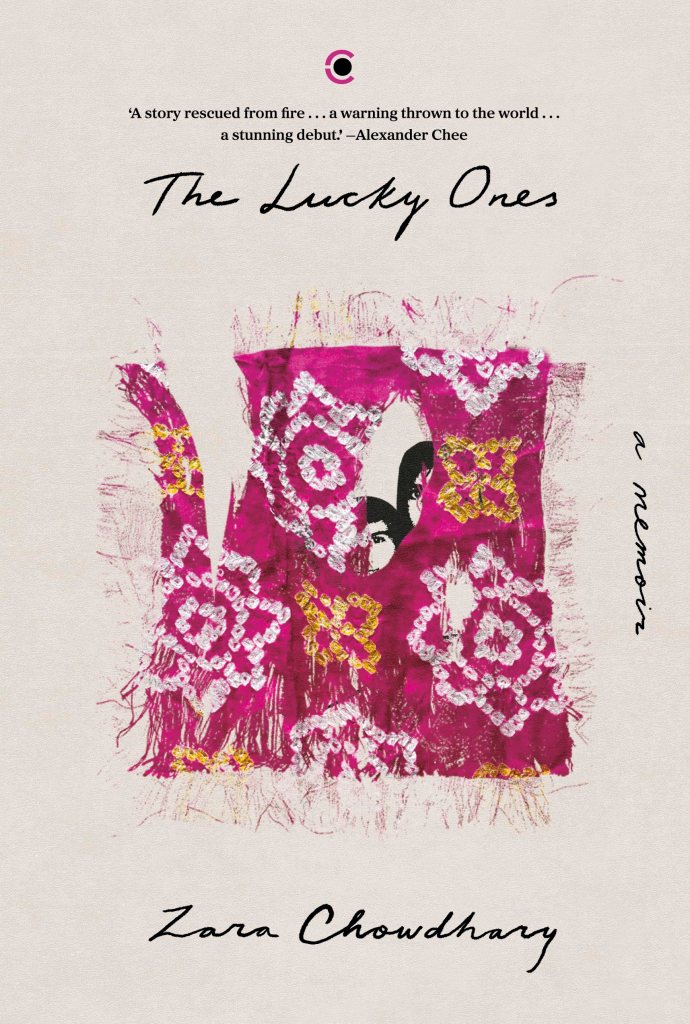
Zara Chowdhary’s memoir The Lucky Ones (2024) does breach the silence. Zara, who was around sixteen years of age when the 2002 riots occurred, experienced the horror of it firsthand and witnessed how the world around her had started to shrink into ‘Hindu’ and ‘Muslim’ spaces. Zara observes that the city she inhabited was different from the one that her grandmother, her father and her Phuphu (paternal aunt) had grown up in – for them, Ahmedabad was less alienating. For her elders, the bridges across the Sabarmati River brought together the old city and the new city of Ahmedabad, but for Zara and her peers, these bridges became instrumental in distancing the eastern and western flanks of the city. For Zara, memories of riots translate into unresolved trauma that she carries within her psyche for decades. For her, the resolution comes in the form of this memoir and hopefully works as a mode of cathartic redemption.
Zara observes in her memoir that hate is something that “builds in microcosmic ways.”[4] To illustrate this, Zara uses her apartment complex, Jasmine, as a metaphor. She maps how the India she had known had mutated from being a secular space into a rigid, venom-ridden, and religiously fundamentalist space wherein the Muslim was seen as the ‘grotesque’ post the Godhra riots. Zara writes that Jasmine, as an apartment complex, used to be a secular space “filled with families of every state, faith, language and caste of India,” where “[s]ecularism and pluralism weren’t distant constitutional values here; for (they) constituted the very names of the Jasmine name board by the elevators,”[5] but this soon changed after the 2002 riots. The Hindus started to go across the Sabarmati River to the new city, and the Muslims started coming towards the old city, each seeking safety in ghettos of their community, ghettos of their own making.
Elsewhere, Zara recalls the sense of fear that constantly assailed her. The news channels blaring on TV and the elders talking in grim, hushed tones made it impossible for children to be immune to the violence around them. She mentions in her memoir how she and her peer group would sit and obsess about the riots: “[o]ur group has spoken about nothing but the massacre for weeks, a morbid fascination only children under trauma can have for death. We have even roughly calculated how long it will take for the mob to reach each of our apartments. Eight floors would take ten minutes for Misba and me.”[6]
The sense of doom is heartrending – for Zara knows how it feels to be a child trapped in a conflict-ridden space.
K.G. Subramanyam, When God First Made Animals, He Made Them All Alike (2020)
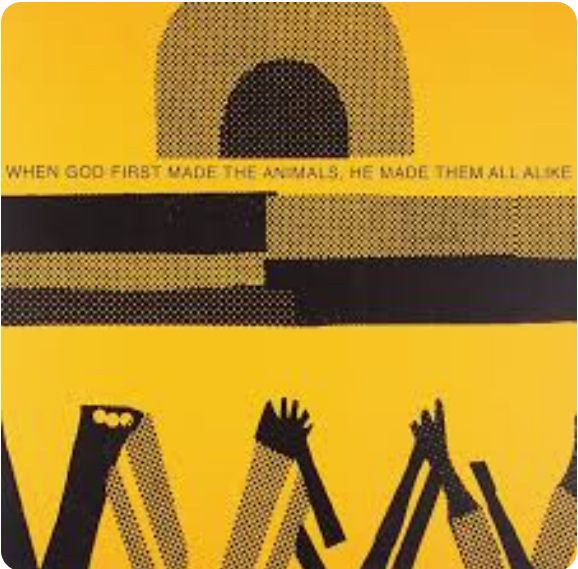
If Zara’s memoir is inspired by her traumatic experience of the dystopic Gujarat riots of 2002, then artist K.G. Subramanyam’s (1924-2016) experience of the haunting memories of the 1969 and 2002 Gujarat riots finds expression in his paintings and artworks. After witnessing the riots in Gujarat in 1969, Subramanyam wrote an illustrated book for children wherein he tries to impart to children lessons regarding assimilation, empathy, and warns them about the ills of ‘Othering’. In 2002, after witnessing the horrific Godhra riots, K.G. Subramanyam wrote a poem titled “Gujarat, 2002”[7] in which he strongly condemns communal violence. This article focuses on his graphic book titled, When God First Made Animals, He Made Them All Alike,[8] (2020), where Subramanyam uses a fable to tell children the story of how, once upon a time, all animals were made alike. However, they gradually chose to fashion themselves differently, each jealous of the other, each hoping to be the most majestic. This process of distinguishing between the ‘self’ and the ‘other’ had something akin to pleasure, but it was short-lived. As Subramaniyam writes, the ‘trappings’ became old and faded, and
Instead, since they looked and spoke different,
they lost the power to understand each other;
they grew jealous of what the other had
and looked upon each other with suspicion.
So now, they snarl at each other when they meet.
They kick each other, horn each other, tear each other
with teeth and claws.
They belt each other with their tails.
Often they do worse things.[9]
Subramanyam, in an extremely simple and unassuming way, teaches children, to whom this graphic book is addressed, how to avoid conflict, to co-exist, and live in harmony. The book ends with the wisdom that even now, the hope lies that the animals would forget their differences and
“Live in peace and be happy.
In this hope, the story is told over and over.”[10]
Through this simple narrative, Subramanyam beautifully attempts to attune children to the need to forget ‘differences’, for a world fraught with differences can only be a harbinger of discord.
Both the texts, one a memoir, the other a fable, deal with children in their own unique ways. While Zara’s work offers us rich pathways into understanding the psychological impact on children when they experience fear and trauma while being trapped in conflict situations, Subramaniyam’s work is a way of teaching children the significance of being tolerant and understanding each other.
[1] De Capitani, Lucio. (2020) “Riots, Crowds and the Collective in Amitav Ghosh’s Political Imagination. From The Shadow Lines to Gun Island” Crossing the Shadow Lines : Essays on the Topicality of Amitav Ghosh’s Modern Classic edited by Adami, Concilio, and et. al.
[2] Kumar, Kamayani. Articulating Childhood Trauma: In the Context of War, Sexual Abuse and Disability. Routledge India. 2024
[3] Maitra, Shubhada & Ramaswamy, S. & Sirur, S. Use of play and art forms with children in disaster: The Gujarat experience. Indian Journal of Social Work. p.263. (2002).
[4] Chowdhary, Zara. The Lucky Ones: A Memoir. Westland Books, 2024 p. 188
[5] Ibid p. 189
[6] Ibid p. 115
[7] Subramanyam, K.G. Gujarat, 2002 in Poems. Seagull Books, 2007.
[8] Subramanyam, K.G. When God First Made Animals, He Made Them All Alike Seagull Publications, 2020.
[9] Ibid p. 32
[10] Ibid p. 34
Dr. Kamayani Kumar is an Associate Professor of English, Aryabhatta College, University of Delhi, India. Her PhD from the Department of Humanities and Social Sciences, Indian Institute of Technology, Delhi focused on children as victims of Partition-induced trauma and the transgenerational transmission of Partition as a cultural trauma. Her recent publications include Articulating Childhood Trauma in the Context of War, Sexual Abuse and Disability published by Routledge. Her work on children as victims of conflict in India as examined through literary and visual narratives is soon going to be published by Palgrave McMillan.