– Kajori Patra
You must have heard of Gaganendranath Tagore — one of the leading artists of the Tagore family, the brother of Abanindranath Tagore, Jyotirindranath Tagore’s protégé, the illustrator of Rabindranath Tagore’s Jibansmriti and a determined proponent of swadeshi. Unlike his illustrious brother and uncles, Gaganendranath was a somewhat loner, in his span of 40 years of life, he had authored a single book. A keen artist trained in European art forms, Gaganendranath was a flexible artist who blended Western techniques of watercolour and interplay of light and darkness with Indian subjects like pukur paars, houses, villagescapes, rivers and cities [i]. Remember the child Robi in Shishu Bholanath? Idyllic in his Romantic gaze across the uthon as his teachers prodded him to study — the proto-Rakhal whom Sibaji Bandyopadhyay would identify as the rebellious colonial boychild? This boychild is the main hero and narrator’s alternate self in Bhondor Bahadur [ii], the only book written by Gaganendranath Tagore.
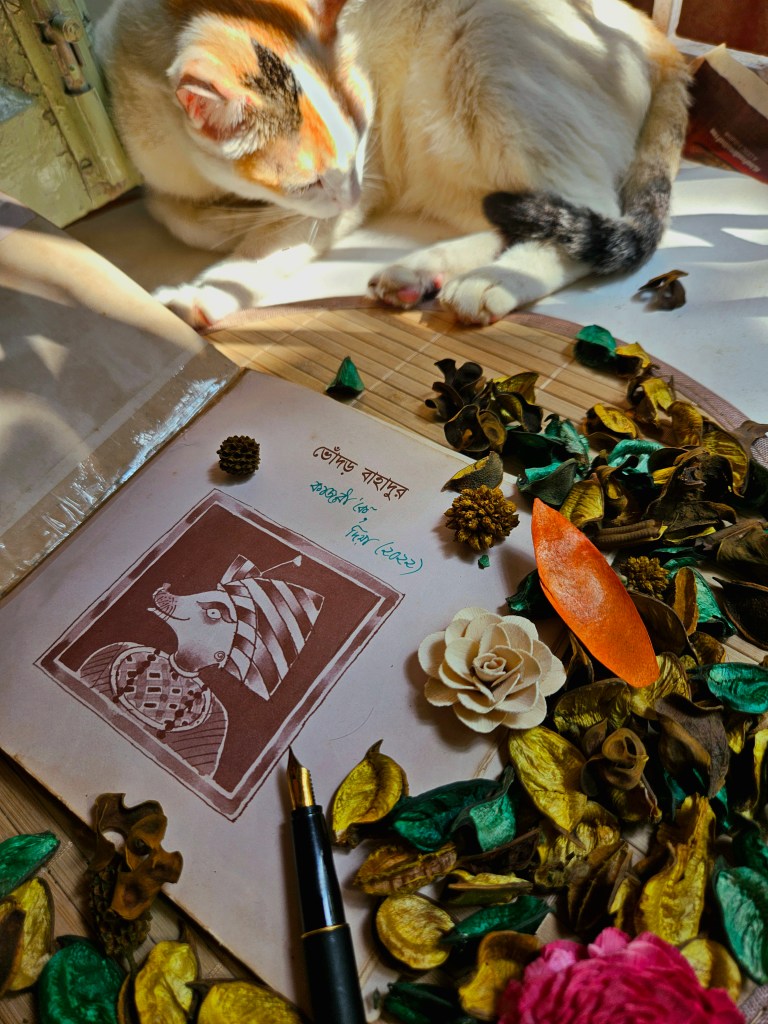
Gaganendranath Tagore. Bhondor Bahadur. Shishu Sahitya Sansad, Calcutta. This edition: 1995.
(Cameo by Kajori’s Cat)
As the novella begins, the adult, old really, protagonist enters a dreamscape where he once again becomes a five-year-old who can ride his toy wooden horse. In what will become a mock-epic and a mimic-siege, the adult no longer possesses power on the narrative, even his (adult) solution at the beginning, “Let us go seek help from the police, then!” [iii] falls on deaf ears, as who has ever heard of the police battling a mythical demon? In the manner of the kinship model of approaching children’s texts as Marah Guber proposes, Tagore chooses to not remain an adult trying to poke holes in the child’s worldview, and instead transforms himself into one. In the carnivalesque world that is the dreamscape, the child is more capable of fighting a demon and retrieving a lost prince than the adult, white-haired author-narrator. And in the end, when after glimpsing the ethereal Jotéburi, a divine, maternal character reminiscent of Abanindranath Tagore’s Bharat Mata, the fantastic dream is broken by a rather rude, realistic call by a domestic help, “Sir, your tea is ready!” Apart from denouncing the spatial displacement, Tagore’s boy hero strives to botch up the colonisation of time that allows it only a linear progress of modernity, as all non-modern States are expected to follow a predetermined trajectory. When the boy leaves the old, decrepit body of the narrator and embarks on a journey, the time that his corporeal body experiences is only, maybe, an hour or so during a leisurely nap. But in his dreamscape, he escapes the limits of linear time by enacting an entire series of bravados – stealing a platform, defeating a demon, meeting mythological characters – over a period of, at least, one day. In the normative construction of time that marks children as ‘lacking’ and needs them to practice a timed discipline, the child is not considered a true citizen because of his/her inability to manage time. In Tagore’s understanding of the child as the master of time, however, while the adult takes a lazy, hour-long nap, the child is able to perform multiple, odious, extravagant tasks – there comes not only a sleep/work binary but also an hour/day distinction. Thus, through the dream, he essentially travels backwards in time, from an old narrator to the young boy hero, although his other companions remain adults – albeit, animals – and even as old as his ’real’, former-adult self. Only the protagonist must age backwards as a child, while the adult animals remain able to embark on the same (childish?) adventure as him. While it is a graver concern whether this allows the animals a greater agency than humans in children’s fiction or whether the child is equated to an animal, that discussion should perhaps be kept aside for another day.
In Bhondor Bahadur, we see an obvious effort to re-read Alice in the Wonderland, the curious Victorian girl child who must worry about eventually returning to reality and growing up (with her impending marriage hinted at by her sister) is replaced by the colonial boy child, who is already simultaneously a grown-up and has, thus, less to worry about and more license. In fact, a number of colonial texts, like Kankabati by Trailokyanath Bandyopadhyay and Kheerer Putul by Abanindranath Tagore, display a fidelity to the Alice texts. Just like Alice, Gaganendranath’s boy protagonist too must remain in the ‘real’ safe space of home, and unlike unruly, run-away children of colonial Bengal who were often termed “vagrant” or “urchins” (Balagopalan, 2014 [iv]), the boy does not have the physical freedom to go out and have a geographically-alternative adventure. His only journey is through his mind. But that also becomes his strength. The absence of several ‘real’ rules in the dreamscape allows the boy to conjure many fantasy elements. In fact, in reworking Carroll’s nonsensical world, Tagore surreptitiously uses several indigenous or folk motifs, often creating puns – the less-humorous of us will label them as dad jokes. For example, to replace the ticket checkers (called ticket ‘babus’) in the human train stations, the dream-station is populated by ticket babuis or tailor birds. I chuckle every time I read the line. The character of Badyiburo, a traditional medicine man, is a folk healer who uses the indigenous method of cooking and grinding tree bark, bulbs, roots and other natural ingredients into effective tonics.
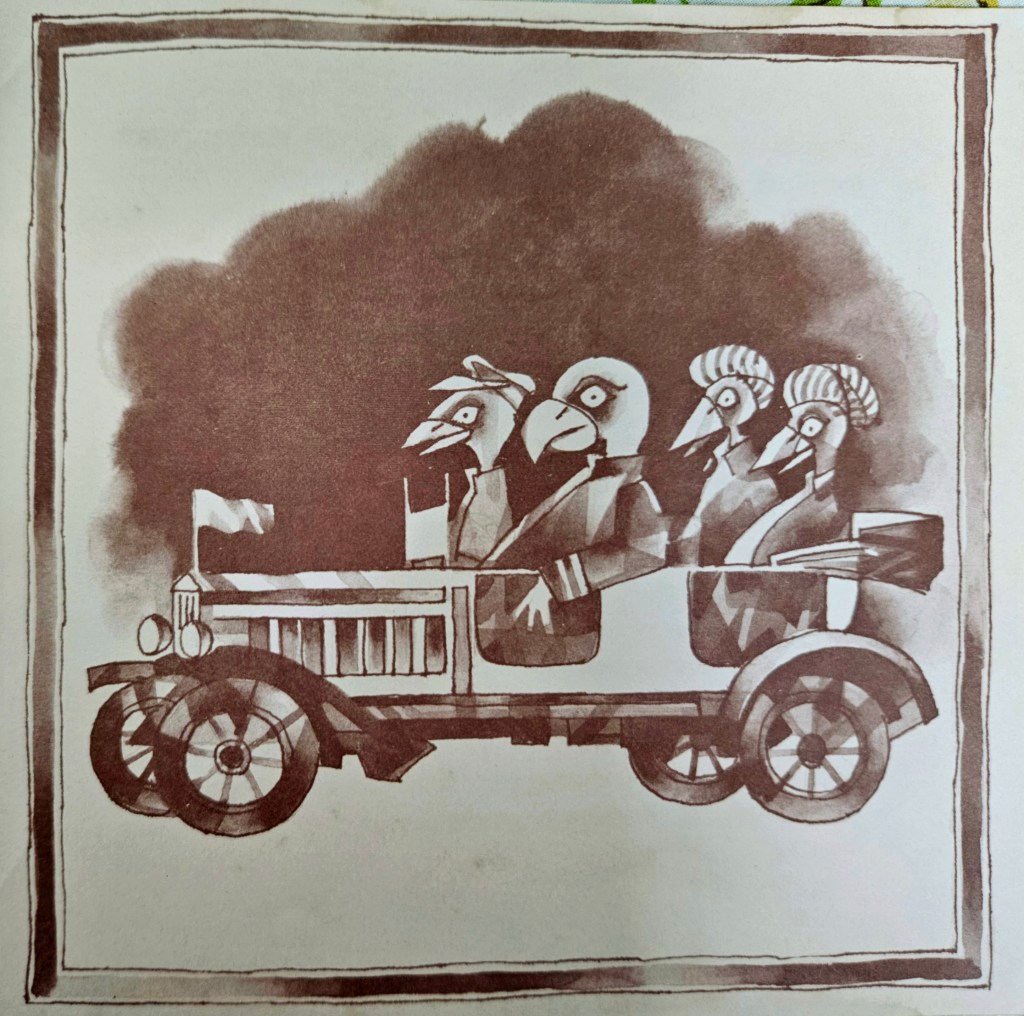
“Tiye Saheb”
Gaganendranath Tagore. Bhondor Bahadur. Shishu Sahitya Sansad, Calcutta, page 23.
Tagore was also a master of satire and was responsible for several art pieces mocking the high-brow society’s hypocrisy. India has had a long legacy of anthropomorphised animals mimicking the behaviours of people from various social strata. Think Panchatantra – where lions were usually depicted as rulers, cruel or kind, and jackals as clever ministers, or the Hitopadesha where elephants and mice work together to mutually benefit from each other. Unlike the beast tales from South Asia, mock heroes were more popular in the West – and eventually, in India too, as the “Der Angule” in Thakurmar Jhuli. The burlesque Kunstmaerchen, a genre which strove to please its readers by making its heroes cunning or gauche in their behaviour, became the satire’s precursor in texts like Rape of the Lock or Don Quixote. The most delightful thing about Bhondor Bahadur is not just the fact that a young boy must travel with a kingly palm civet, rather plainly named, Bhondor, dressed in decorous costumes to rescue the civet’s son, an equally stately civet, Nichua. It is the fact that as a child, when I read it, it was a siege as real as sepoys being led into a formation during a military attack. The grandeur of the siege could only be summarised as ‘mosha marte kaman daga’ – to go to great lengths to complete an insignificant task. Tagore unleashes the full potential of a mock epic in Bhondor Bahadur – and why would he not, when he had such a number of themes to play around with? In “Ekushe Ayin”, Sukumar Ray tacitly mocks the lack of logic in several colonial-era laws. In a similar breath, Tagore takes his deep dig at the British raj. His mock soldiers wear red and gold uniforms, sharing eerie similarities to British constables and officers. When the group reaches the train station (since this is a modern-day siege, they ditch the long travel-hours of horseback-riding and decide to take trains) the officers are all seen to be taking a nap, and Bhondor bribes one of them in order to get on a train urgently. Even in dreams, one must pay the government its due. And, eventually, when they do get the platform moving (instead of the train), the police charge them (and not the clearly corrupt and inefficient railway officers) for damage to public property. An Indian ballad of an undignified hero — even a great fan of Bhondor Bahadur must cede to the rather insignificant status that a palm civet would possess, he is neither glamourous like a lion nor beautiful like a dove — serves as but a comic work meant for young children.
As a mock epic, it allows the carnivalesque reversal of insignificant animals and a child donning military uniform to heroes going to war. Tagore even furnishes a miniature army that will accompany our heroes in their task, the members of the army, comprising of literally small mammals and birds, choose a fitting parade space – the terrace. Instead of a martial chant, they sing nursery rhymes. Before leaving, the heroic trio must meet Bhondor’s wife, who seems inconsolable and needs to be looked after by Umno and Jhumno – typical of Bengali households, the two civet princesses have ugly, matching names. Heroic tropes, like the fainting wife or the hero taking an oath to complete a task, appear in a rather hilarious manner as the wife, who was weeping and swooning, quickly composed herself and extended a formal dinner invitation to the boyhero!
Tagore also makes the choice of retaining urban and Western features within the medieval and Indian epic structures. Thus, while all the animals and the boy decide to commit what is essentially an honour sacrifice of their lives by burning on a pyre, the parrot – a police officer – remains unmoveable in his desire of being shot to death as a serviceman. Similarly, an underlying joke of police incompetence runs throughout the text and becomes prominent when the police officer (parrot) himself says that he cannot trust the police to retrieve his son as well. Despite these, Bhondor Bahadur remains Bengali and swadeshi at heart, with Tagore’s recurrent usage of mythological titbits to contextualise his fantasy, as other members of the Tagore family were prone to as well, at the heart of the nationalist movement. Mentions of the Maya demon, in a folktale-like story narrated by the fox, and allusion to Ramayana make the text uniquely Indian. And in the end, the dream gives way for the author to wake up on the morning of Navami, just after visualising a loving, maternal deus ex machina, Jotéburi, reminding readers about the akal-bodhan where Ram, along with his makeshift army, had prayed to the Goddess Durga to defeat the demon-king, Ravan. Eventually, the goddess visited him, an unseasonal visit, therefore, the akal-bodhan. Jotéburi wears a floral saree and floral ornaments and with her feline companion, she appears like the deity, Shashthi, while also harking back to the nationalist project of introducing a deshomatrika-like character – the one who resembles the nation state as the mother with her swadeshi yet elegant attire and the divine yet benevolent powers. Like a dextrous sieve, Tagore altered and combined a substantial amount of Western sensibility within Bengali storytelling.
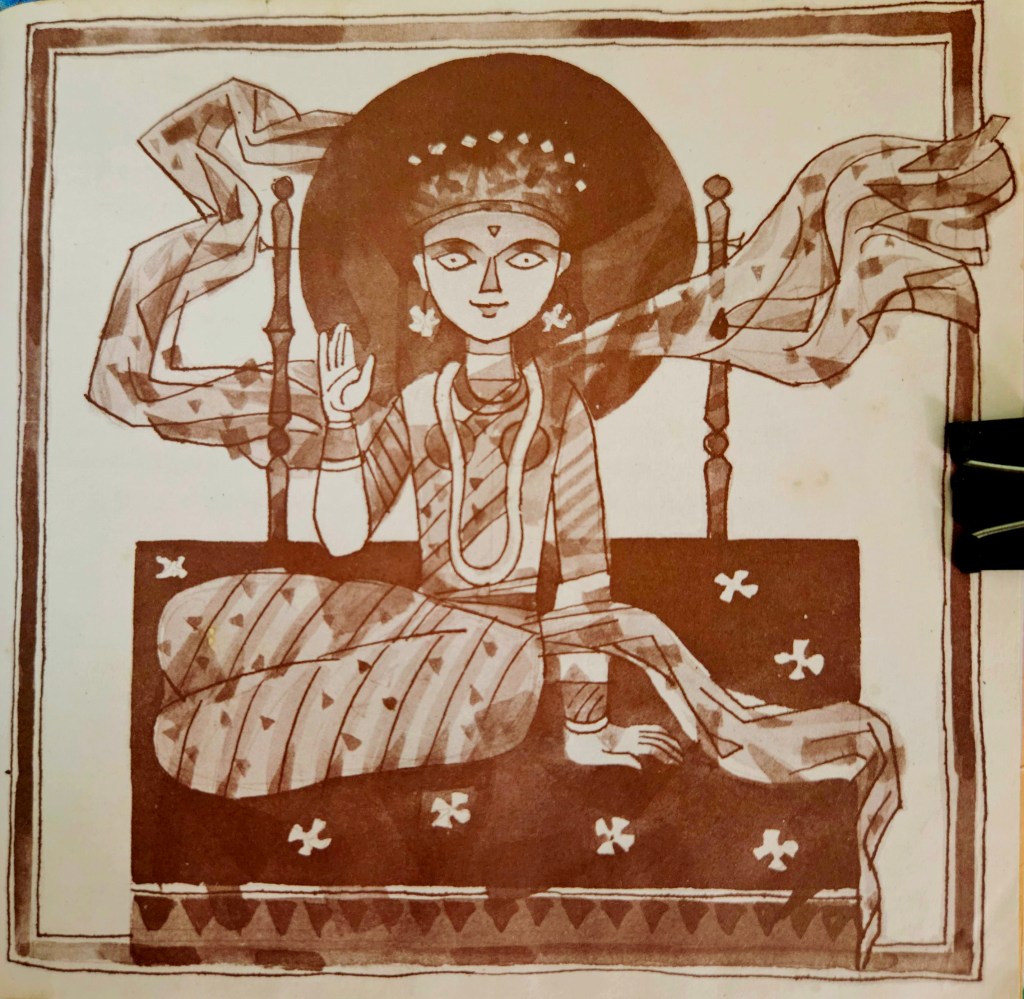
“Joteburi”
Gaganendranath Tagore. Bhondor Bahadur. Shishu Sahitya Sansad, Calcutta, page 39.
Perhaps Gaganendranath Tagore’s untimely death arrested any further possibility of authoring any other children’s text, for the absence of more works displaying such brilliance of thoughts and delectable prose is a loss for Bengali children’s fiction. Throughout the text, there are nuggets of ‘side quests’ or threads of stories that are never tied up, which keep alive the readers’ desire for yet another adventure. Tagore sometimes gives into metanarratives – story within story – structure but he also refrains from straying too much from the primary plot. Like in dreams, all loose ends are not tied together and we have no other option but to sigh with disappointment as one of our professors did while teaching us Don Quixote: “Don ki hotey ki hoiya gelo!”
[i] R. Siva Kumar, Paintings of Gaganendranath Tagore. Pub: Pratikshan, Kolkata, 2015.
[ii] Translation available: Fantasy Fictions from the Bengal Renaissance: Abanindranath Tagore, ‘The Make-Believe Prince’ – Gaganendranath Tagore, ‘Toddy-Cat the Bold’. Sanjay Sircar. Oxford University Press, 2018. Original copy of author’s text: Thakur, Gaganendranath. Bhondor Bahadur. Shishu Sahitya Sansad Pvt Ltd, Kolkata: 1995.
[iii] All the textual translations from Bengali to English are by the author.
[iv] Balagopalan, Sarada. Inhabiting ‘Childhood’: Children, Labour and Schooling in Postcolonial India. Palgrave Macmillan, 2014.
About the Author:
Kajori Patra is the Subeditor of the opinion pages of The Telegraph. Her research interests include Bengali children’s literature, translation studies and migrant childhood studies. Please feel free to reach out to her at thekajoriscript@gmail.com. She can also be found on Instagram as @bookisque and Twitter @not_cleopatra.