
Once upon a time, there was a cheerful and curious girl who loved hearing stories. Her nap time commenced with a story each day after a heavy midday meal. Her imagination ran wild as her aunt told her tales of demons and fairies. In her head, she was always the child in the story, facing difficulties, and her dad was the hero who rescued her safely. The girl in the story is me! Travelling back in time to relive those days of innocence makes me feel nostalgic.
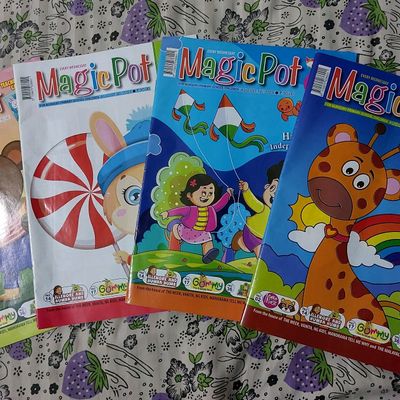
As a child, I had very supportive parents who encouraged me to read to my heart’s content well outside the academic stock. They had signed up for a subscription to the children’s periodical in English by Manorama, Magic Pot, which became the portal through which I entered the literary world of imagination. The periodical appeared every Wednesday on my doorstep, enclosed in a white plastic envelope addressed to my name. The fond memories of tearing open the encasement, looking at the appealing cover page filled with colour, feeling excited to find a small freebie and a gush of enthusiasm to work with my art kit still flash before my eyes.
I remember, the magazine had short stories, comic pieces, riddles and rhymes, and crafty colouring exercises. The periodical is a wholesome package to entertain and engage a kid in material and intellectual ways. My favourite is the long-running comic “Mayavi and Luttapi”, a story of the archetypal good versus bad angel. In my head, I always associated Mayavi with the hero in the stories narrated to me in my childhood, my dad. The content in the periodical was very localised but, at the same time, could cater to the sentiments and needs of children everywhere. Each story had a moral embedded while at the same time keeping intact the entertainment factor. Also, the elements in the magazine appealed to the child’s growing perception of the world by introducing ideas about eco-consciousness, gender identity and cultural sensitivity.
Indeed, my early childhood experience with Magic Pot has played a crucial role in the language skills I possess today. To think of it from an academic perspective, the number of genres I was exposed to, from folktales to science fiction, rhyme to poetry, is massive – all the time remaining age-appropriate. The creators of this magazine made and still make sure to keep it simple. The words, pictures, and activities are given in a form that is graded to suit the entire spectrum, from kindergarten kids to primary school children. That is the USP of the Magic Pot.
But curiously enough, I doubt if this periodical was famous all over India. Hailing from the southern part of India, I have seen my peers from different sections of South Indian society enjoying the magazine. Owing to this factor, the characters’ names in the stories and the comics mainly were ‘southernised’. Stock South Indian names such as Ravi, Tinku, Deemu, and Lala allowed me to place these imaginary friends parallel to my next-door neighbours as a child.
I still remember how the “Tales from Puranas” section in the magazine was so attractive. A small anecdote I recollect is, after watching the Ramayana series on television one weekend, I opened Magic Pot to find the same episode from Ramayana where Ram helps Sage Vishwamithra. I was intrigued by the similarities and differences in the representations of these characters in the illustrations and the realistic portrayal on television. It was a moment of revelation and discovery that a vast gap exists between imagination and reality. As any child would prefer, I embraced the imaginary world with zeal. In the mission to cultivate values, creativity, and skill delightfully, Magic Pot offered me a genuinely magical companionship and continues to be for many children.
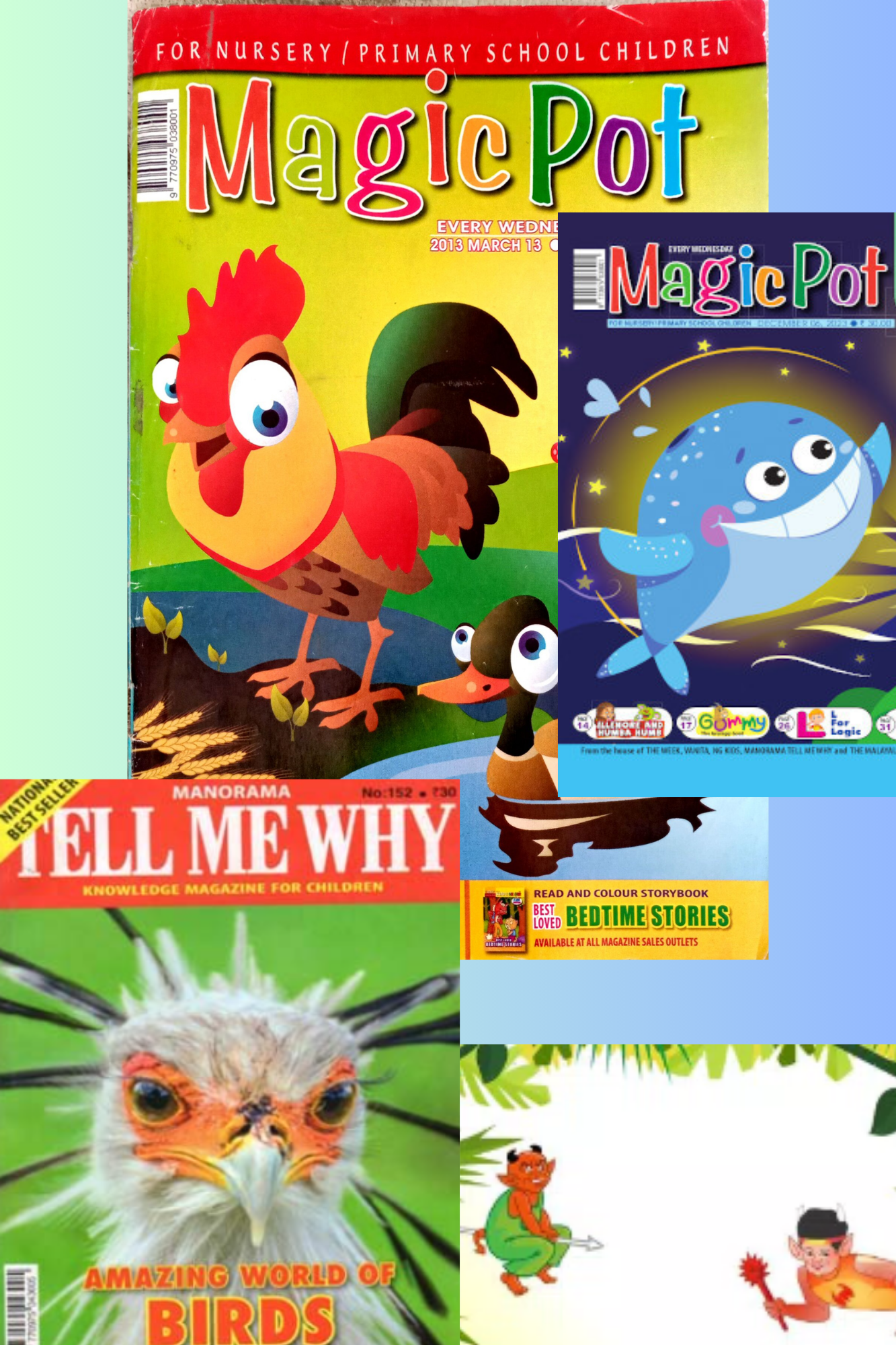
Well into my pre-teens, I still held to this excellent companion. It became a comfort zone while I slowly progressed into more age-appropriate reading material such as fiction and novels. Another periodical that intellectually stimulated my mind was the more advanced Tell Me Why?, which appeared alongside Magic Pot for an older age group of children. Every edition of Tell Me Why? is focused on a broader theme. The topics chosen are comprehensive, covering history, arts, philosophy, science, and many more. The narratives around the topic are covered in a very engaging and straightforward manner.
I still remember how fascinated I was with the edition that dealt with Egyptian mythology and history. The small quarto-sized book with some fifty pages had vivid pictures, callouts with interesting facts and a narrative style which can be appealing to child readers. I still possess the collection of Tell Me Why-s as a precious memory. They were not just mediums of information but also life-savers when projects were assigned in school. In a time when Internet access was minimal, these periodicals became a huge academic bank of knowledge. I remember how detailed the information was in editions that dealt with history and culture. This particular edition on Wild Animals was a treasure trove for me as I had to create a photo album with pictures and facts about indigenous and endangered species in India. When the teacher announced the project, I was comfortable knowing my Tell Me Why? would be there for me. I owe my current geekiness to the time I spent with these treasures of knowledge.
Well, I hope Indian childhood is still framed by the delight and curiosity these periodicals brought into my life. They were sometimes a comforting presence, sometimes an illuminating experience. These magazines have been an integral part of my childhood. As a budding scholar foraying into Children’s literature, I hope the experience these magical companions have given me will be significant in my life journey.
Author Bio

Ms. B. Sai Harshitha is currently a doctoral research scholar in the Department of Languages and Literature – English at Sri Sathya Sai Institute of Higher Learning, Anantapur Campus. Her area of research is Indian Children’s literature and she is specifically interested in Indian picturebooks in English. She has published a few articles in peer-reviewed journals.

Nice may you leap into greater heights in future, Best wishes.
Nice my best wishes for your future assignments, my blessings for you to leap into greater heights in future.
Astonishing . Superb my dear. May you Succeed in all your endeavours.