
Swarachita Dasgupta
Reality, in itself, is a subjective notion. Each and every individual’s personal experience culminates to offer them their own picture of reality, every part of which is ‘real’ to them. This makes us question how we are to distinguish the real from the fantastic, the normal from the absurd, the sense from the nonsense. We, as adults, are quick to dismiss and discard everything that does not fit the normative standards, but we fail to understand that these standards are essentially arbitrary with no fixed grounds to validate them as the only truth. Reason and rationality does not plague the minds of children. Like the Blakean lamb, their innocent mind does not find it hard to perceive and believe in miracles.
To transgress and go beyond the boundaries of the known and the purported ‘normal’ is an essential part of Children’s Literature wherein literary Nonsense is a distinctive feature. As the name suggests, ‘Nonsense’ always exists in relation to the ‘sense.’ T.S Eliot commenting on the presence of Nonsense in the works of Edward Lear says that it is “not a vacuity of sense; it is a parody of sense and that is the sense of it” (Eliot, 1957). It stems from the realization that of the hollowness of the foundation our belief system is laid upon; that the sense and rationality on which humans base their pride are not natural but a fabrication of their own minds. As such, we can perhaps establish that the very codes of sense and logic are actually fantastical – it is only because we are forced to pin our absolute faiths on them that we make them a part of what our reality consists of. In the use of the element of Nonsense, thus, we find an upfront challenge to the authority we have assumed in setting demarcations and categorizations.
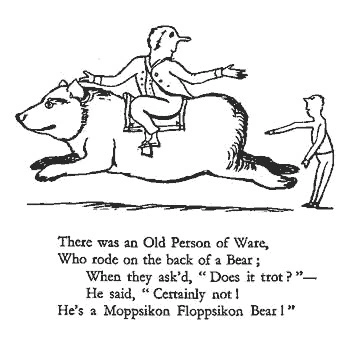
According to the definition provided by the Merriam-Webster dictionary, Fantasy is ‘the power or process of creating especially unrealistic or improbable mental images in response to psychological needs’ (Merriam-Webster, online). This realm of fantasy is created through the faculty of imagination, curiosity and the desire of exercising free will. There exists a tendency among the adults to restrict and confine children within specific bounds and the latter remains vulnerable to it because of its total dependency on the former. Fantasy and imagination therefore, emerges as a process to assert independence and free will:; the creation of a world as real as anyone else’s reality and possessing the element of wish-fulfillment so that the child enjoys the happiness which the apparent ‘real’ world denies him of. Fantasy therefore, acts as a corner of joyous retreat of the mind while keeping it critically engaged and ultimately helping in the act of self-exploration.
The element of fantasy and wish-fulfillment heartily blooms in Upendrakishore Raychowdhury’s creation of Gupi and Bagha and their adventure in Gupi Gayen Bagha Bayen (1915), which was later widely popularized through a film adaptation by his grandson, the great filmmaker, Satyajit Ray. I am, here, solely concerned with regards to the film Gupi Gayen Bagha Bayen (1969).
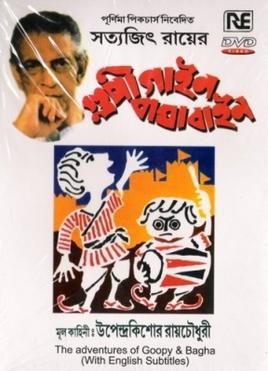
With its fairytale-like feature, Gupi Gayen Bagha Bayen presents a world filled with ghosts, boons, wizards, wit and miracles. The story traces the adventure of the two protagonists, Gupi and Bagha, as they navigate their lives in a world that blurs the line separating the mundane from the supernatural. At the initial stage both Gupi, the son of a poor grocer, and Bagha are shown to be passionately drawn towards music. The village elders make Gupi a scapegoat for their own entertainment as they secretly mock his singing and convince him to sing for their king early in the morning. The enraged king drives Gupi out of the village for his terrible singing. It is during this exile that Gupi encounters Bagha, a drummer, who has shared the same fate as the former. While being disappointed about their desolate predicament in the woods, they manage to please the troop of ghosts along with the Bhooter Raja (King of Ghosts), with their music and are rewarded with three wishes. After not much pondering Gupi and Bagha ask for things they consider the most important to them: to eat whatever they want, to go wherever they want, and to make people listen to their music every time. It is worthy to note here how the fantastic element in the story manifests itself not through the incorporation of any fairies, angels or gods which are generally associated with the qualities of optimism and benevolence, but through the agency of ghosts which are stereotypically thought to be associated with evil and cruelty. This inversion of qualities through the portrayal of benevolent ghosts not only encourages the minds of children to not regulate their imagination based on opinions imposed on them, but also shows a glimpse of how nothing impossible lies in the realm of fantasy, – that everything is possible in a reality that we create for ourselves. The three wishes through their highly fantastical quality present their symbolic importance., Tthey represent the essential desires of any individual wanting to thrive and live: unrestricted food, exploration of new places, and expression of latent talent. Bridging the gap between people of various age groups, these wishes strike at the very core of each and every individual leaving us to ponder what we really want from life and what would truly make our ‘real’ life as good as the imaginary one.
Full video including Bhooter Raja: https://youtu.be/rmc-gCXeLN8?si=dd_8Xo7g62a4xlS1
Gupi and Bagha next set out to compete for the position of court musician in the kingdom of Shundi, a land where its inhabitants are under a wicked spell of dumbness. They emerge victorious and soon become a favourite of the King who shares with them the news of the danger that has befallen on the kingdom. The King’s twin brother, the king of the neighbouring kingdom Halla, has asked him to either surrender within three days or face a war. Gupi and Bagha, quite confident of their magical qualities, promise the King of Shundi to investigate the problem and resolve the conflict. What follows is the episode where they reach the rival kingdom and piece together the information that the evil minister with the help of a wizard has kept the twin King in a state of trance during which they make him behave like a tyrant. It is ultimately through their passionate, thought-provoking music mingled with the boon of magic that they emerge successful in mesmerizing the king and inversing the spell of the wizard, thereby stopping the war. As a reward both the Kings of Shundi and Halla offer their daughters’ hands in marriage, elevating the status of Gupi and Bagha to that of princes. What emerges from this story of miraculous rags to riches transformation is a striking metaphorical message: being steadfast, hopeful, kind, and having belief in oneself will aid us to overcome all adversities. This mingling of didacticism within the context of a fiction based on fantasy is a proof of how ‘sense’ can be attributed to anything if we really want to. The breaking and re-making of our rigid conception is what it aims at.
The mistake that many readers make while dealing with Children’s Literature is to fetter and bind it in chains, constricting the piece to a specific audience: the children. This is exactly what each of these pieces aim against. Inversion of the set boundaries and limitations in view of the ever-widening scope of human potential is why incorporation of the element of fantasy is so important in them. Their primary recipients are children because they have the innate tendency to question the mould which society constantly tries to fit them into. In case of adults, the element of Nonsense targets to question and undo the thorough conditioning they have been subject to throughout their lives which compels them to treat normativity as the only possibility.
Children’s Literature offers an insight to critically judge various demarcations and differences that we have quite unjustifiably set up as the customary and into how the imaginative faculty of the mind can truly bridge the possible and the impossible. Stress should be laid on the fact that although the world of fantasy offers a sense of solace and of wish-fulfillment, it does not push us to adopt an escapist attitude. The concept of the construction of individual reality implies that we need to blend the line separating ‘what I want’ and ‘what I have’ through our own actions, values, and ideals.
Eliot, T.S. On Poetry and Poets. London: Faber and Faber, 1957.
Raychowdhury, Upendrakishore. Gupi Gayen Bagha Bayen. Sandesh, 1915.
Gupi Gayen Bagha Bayen. Dir. Satyajit Ray. Purnima Pictures, 1969.
Merriam-Webster. n.d. https://www.merriam-webster.com/dictionary/fantasy
Author Bio
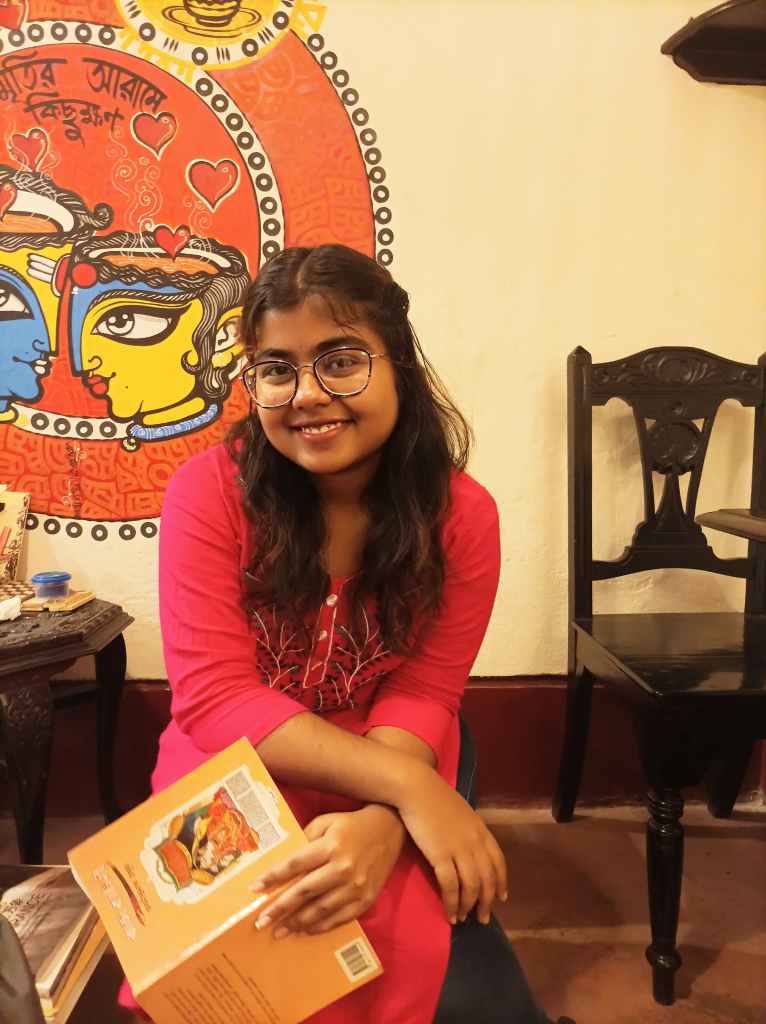
Swarachita Dasgupta is currently pursuing her Master degree in English Literature under the University of Calcutta. Her interests lie in the exploration of Indo-Anglian literature with a
special focus on Diaspora and Identity Studies. She is always looking forward to collaborate on research-oriented goals.
