

Anandhu S.
The sun sank below the horizon, painting the sky a deep red before twilight took over. Birds flitted across the evening sky racing to their nests as darkness wrapped around the village of Panchavankadu. Adithyan Namboothiri, the youngest of the Kizhekkeparabil family, walked quickly along the shadowy path holding a flambeau made from dried coconut husk. The flickering flame cast a small circle of light around him, his only source of comfort in the encroaching night.
He had just returned from a late-night program and quickened his pace as the woods grew denser. To ease his growing unease he hummed a tune from a Kathakali performance he had seen earlier. Adithyan loved Kathakali — captivated not only by the dance but also by the beautiful women who gathered to watch the festival. A sudden breeze rustled the trees bringing the sweet scent of pala flowers that momentarily enveloped him in a fragrant embrace. But with it came a chill of fear. Stories of Yakshis — ethereal women who lured men to their doom — flooded his mind. Urged by fear he hurried forward, avoiding glances into the shadows that seemed to stretch and move behind him.
Suddenly, he stopped realizing that he had lost his way in the thick darkness. The flickering light of his flambeau barely illuminated a few feet ahead. Though uncertainty gripped him he knew he couldn’t stay still; this was the hour when thieves lurked seeking out those foolish enough to wander alone. Gathering his courage, Adithyan moved down the path he hoped was right. In the distance, a faint white shape caught his eye. Fear gripped him, thinking it might be robbers. But as he looked closer, the figure became a dark blue silhouette gliding gracefully through the darkness. Curiosity pulled him forward, and he crept closer. It was a woman, draped in a traditional saree, her long hair adorned with a garland of jasmine flowers that filled the night air with their sweet scent. Her beauty and fragrance drew Adithyan nearer.
“Hello, lady! Hello!” he called out, breaking the night’s silence.
The figure continued on, unhurried. Finally, she turned, her eyes wide with fear. When he saw her face, he was breathless. She was stunning, her hair flowing like peepal branches, and her eyes sparkled like golden fish. He was spellbound, forgetting the night and its dangers.
“Where are you going? Why are you here?” he stammered.\
“Namaste, brother,” she replied, her voice gentle.
“I’m returning to my illam. I was at the temple festival with my family, but I lost my way. They took another route.”
Captivated, Adithyan blurted out, “Where is your house? I can walk you home.”
He gently placed his hand on her shoulder. “Come, walk with me.”
She stepped back, startled, but he smiled reassuringly. “Don’t worry. There’s nobody here. You can trust me.”
Reluctantly, she nodded, and they began walking together. The path remained dark, the night closing in, and Adithyan’s torch flame flickered, dimming as they moved.
“I didn’t expect to see someone as beautiful as you out here. It’s good I found you—now I have company,” he said, trying to keep the mood light.
The woman only hummed softly, her eyes focused ahead.
Encouraged, Adithyan continued, “You deserve to be by my side, as my wife, not wandering alone. I’ll stay with you… forever if you wish.”
He chuckled at his boldness, glancing at her for a reaction, but she remained distant, responding only with a faint hum. As they walked, his torch cast long, flickering shadows.
After a moment of silence, Adithyan asked, “Where is your home?”
But when he turned to look, his smile froze—she was gone. Panic gripped him as he looked ahead. A towering figure stood before him, still bearing her face but transformed into a monstrous, blood-red Yakshi. Her glowing eyes, long claws, and sharp teeth sent a chill down his spine. Without hesitation, she lunged, sinking her fangs into his neck. Adithyan screamed, but there was no one to hear him. His vision blurred as she drained his life away. Helpless, he was dragged into the night, leaving only the scent of blood and the haunting fragrance of pala flowers.

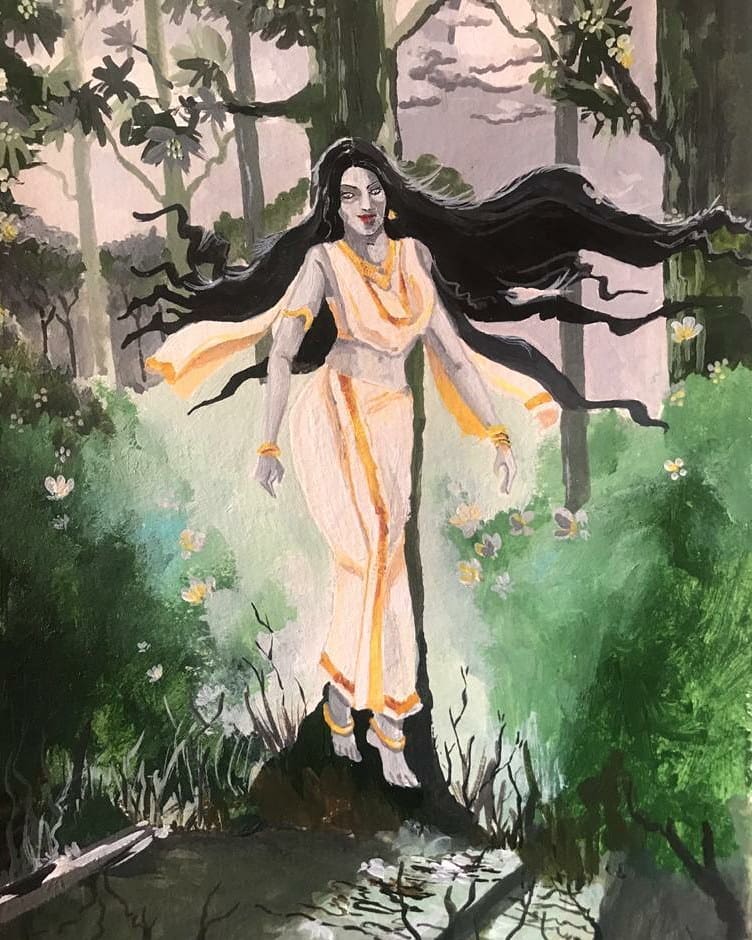
Painting of a Yakshi provided by the author
As our grandmother finished telling the story, she lowered her hands, her fingers mimicking the sharp nails of the Yakshi. My cousins and I sat frozen in fear, our eyes wide with terror. But my youngest cousin, always the brave one, couldn’t help but ask with a trembling voice,
“But grandma, will the Yakshi catch us too?”
With a knowing smile, she leaned in closer, her voice low and ominous. “If you don’t listen to your parents, or if you walk alone at night, the Yakshi will come for you. She’ll sink her teeth into your neck and drink your blood, just like she did to Adithyan.”
Her words sent a shiver down our spines. By the time the story ended, it was already time for bed, but none of us could sleep. That night, the tale of the Yakshi haunted our dreams, the image of the bloodthirsty Femme Fatale who preyed on unsuspecting men lingering in our minds long after the lights had gone out. Every rustle of the trees outside seemed to echo her eerie laughter, and the shadows in the corners of the room appeared to stretch and shift like her form. That was the longest night of my life. Until morning, I lay awake, glancing under the bed and at the corners of the windows. From that day onward, Yakshis became a fearful yet fascinating mystery to me. This fascination with the Yakshi has evolved over time. Who are they? Where do they come from, and what do they seek? Why are there so many stories of Yakshis, and why do they specifically haunt men? These tales of Yakshis are far from simple bedtime stories told to children to encourage obedience or to finish their meals. Instead, they carry a rich history and cultural significance that reaches deep into the past.
In the minds of many children from Kerala, a Yakshi is often seen as a nightmare—a fearsome presence that could descend upon anyone in the silence of the night. But as one grows older, this image shifts. The Yakshi transforms from a terrifying specter into a complex figure—an embodiment of both power and danger. The Yakshi is mentioned in numerous literary and cultural works, such as the novels of Malayattoor Ramakrishnan and C.V. Raman Pillai. The 1968 film Yakshi also captured the imagination of a generation, cementing the Yakshi’s place in popular culture in Kerala.
Yet, the roots of these narratives extend far beyond modern literature and cinema. The stories of Yakshis originated in oral traditions and folk tales, passed down through generations. A close analysis of these tales reveals that Yakshis were once ordinary human women, often powerless and wronged. After death, however, they transform into symbols of vengeance and supernatural strength. A woman who reclaim power through their otherworldly forms.
The myths of Yakshis are not singular but multifaceted, with stories that change and evolve depending on the region in Kerala. In fact, each district of Kerala holds its own unique version of the Yakshi legends, adding to the richness and diversity of the folklore. This leads to fundamental questions: Who are these Yakshis, and where did they come from?
According to The Study of Yakshis by V.V. Haridas, the origin of these Yakshi narratives in southern India can be traced back to at least the early Sangam period. However, the tales of Yakshis are not confined to Hinduism alone; they also find mentions in Buddhist and Jain traditions. In Jain beliefs, Yakshis are seen as protectors of the Tirthankaras, providing a guardian role. Similarly, in Buddhist lore, Yakshis (referred to as Yakkhi or Yakkhini in Pali) are believed to preside over wild places, and their encounters often take place in the forest or at sea, as seen in the Jataka tales.
Even ancient Tamil literature, like the epic Silappatikaram, references Yakshis, indicating their presence in cultural memory for centuries. The concept of the Yakshi is rooted in an ancient tradition, with different names across languages—Yakki in Prakrit, Isakki in Tamil, and Yakshi in Sanskrit. In these traditions, Yakshis are often portrayed as divine beings, embodiments of nature, or guardians of the wilderness.
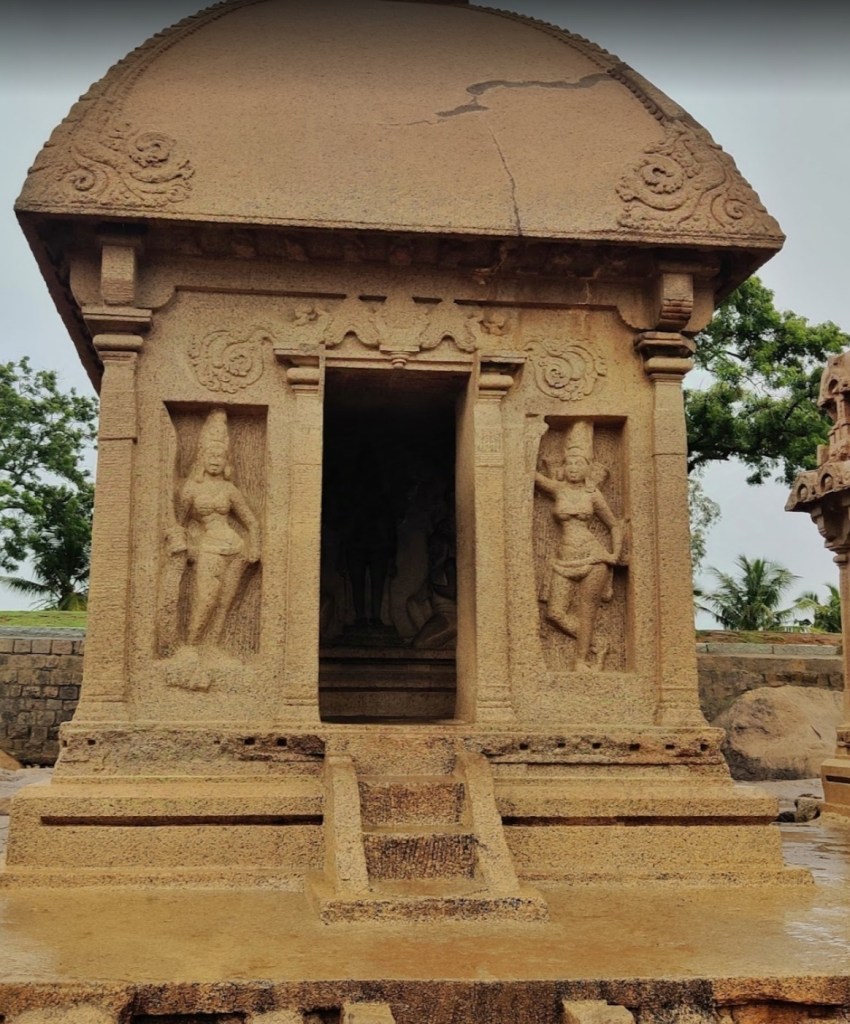
Several ancient temples and rock-cut caves also bear carvings of Yakshis, highlighting their importance in early art and religion. An example of this can be found in the Panchapandava Cave in Mahabalipuram, Tamil Nadu, where Yakshi figures are engraved in stone. In these cultural traditions, Yakshis are revered as goddesses—representations of mother nature and protectors of the natural world. The literature of Kerala, before the expansion of written media, was primarily recorded in Pattu (song) literature. The evolution of Malayalam literature, particularly its poetic form, is categorized into three major segments: (1) Pattu, (2) Manipravalam, and (3) Folk songs. The Pattu literature originates from Tamil poetry and is deeply rooted in the regional linguistic traditions. Following this, various folk songs like Vadakkan Pattu and Thekkan Pattu became popular. The influence of Proto-Dravidian elements is especially evident in Thekkan Pattu (Southern folklore of Kerala). Among the many songs in the Thekkan Pattu tradition, the story of Panchavankattu Neeli stands out. It’s a tale that, like many kids of my generation, I grew up hearing, and even now, it can make me shudder when recalled at night. Here, I share this story with those who have yet to discover the mysterious and haunting yakshi tales of Kerala.
Rock carvings of Yakshi at Pancha Pandava Cave in Mahabalipuram, Tamil Nadu

The story spans across two lifetimes. It begins in Pazhakenallur, a village in Salem, Tamil Nadu, known for its temple where Devadasis are brought from different places to serve. Among them is Sivakami, who has two children, Lakshmi and Thirukandanaduvan. Lakshmi is exceptionally beautiful, and her charm captivates Velavan, a Brahmin priest at the temple. Velavan falls in love with Lakshmi from the moment he sees her, and soon, they develop a deep bond.
Sivakami sees an opportunity to benefit from this relationship. She supports their love, but only to drain Velavan of his money and property. Every time Velavan visits, she demands gifts and gold. Blinded by his love, he complies, even stealing gold from his own home and the temple. Sivakami grows wealthier, while Velavan’s life falls apart. Eventually, he arrives at Lakshmi’s house empty-handed, and Sivakami angrily throws him out without letting him see Lakshmi. When his father finds out about the thefts, Velavan is banished from his home. With nowhere else to go, he wanders into the forest, broken and destitute. Meanwhile, Lakshmi, unaware of her mother’s schemes, is heartbroken by Velavan’s absence. When she learns what has happened, she leaves home in secret, determined to find him and make things right.
After a long journey, she finds Velavan in the forest, worn out and frail. She begs for his forgiveness, explaining that she never knew what her mother had done. Velavan’s love for her makes him soften, and he embraces her. Exhausted, Lakshmi rests on his lap and falls asleep.As she sleeps, Velavan’s bitterness returns. He thinks about all he has lost—his role as a priest, his family, his future. Consumed by anger, he picks up a stone and strikes Lakshmi. In her final moments, she clings to a cactus plant nearby, whispering, “You are the only witness that I truly loved him, yet he did this to me,” before taking her last breath. Velavan flees, carrying away Lakshmi’s gold, but on his way, he steps on a venomous snake and dies from its bite. Meanwhile, Lakshmi’s brother, Thirukandanaduvan, reaches the site where Lakshmi was killed. Overwhelmed by grief upon finding his sister’s lifeless body, he gives up his own life beside her.
Their story doesn’t end there; it begins anew in their next lives. Lakshmi and her brother are reborn as the children of a Chola king, while Velavan is reborn in the city of Kaveri. This time, the rebirth of Lakshmi and her brother is tainted with darkness. As children, they start exhibiting terrifying behaviors—attacking servants, cows, and maids at night, even consuming them. Saddened and horrified by their actions, the king orders the exile of his own children. Abandoned under a neem tree, they transform into Neeli and Neelan. In this new form, Neeli becomes a vengeful Yakshi, a spirit that embodies both wrath and power. From that moment, Neeli terrorizes the surrounding villages, preying on anyone who crosses her path at night. During this time, the chief of Pazhakiyanellur temple decided to renovate the temple. Workers ventured into the forest and cut down the neem tree where Neelan resided. Furious at losing his home, Neelan emerged from the tree and sought to kill the temple’s chief priest. Terrified, the priest fled, calling upon Lord Shiva for protection. Shiva, hearing his plea, sent the asura Kundodara, who confronted and killed Neelan before he could reach the priest.
Unaware of these events, Neeli returned to find her brother slain and her tree destroyed. Overwhelmed by grief and rage, she vowed vengeance. From that day, Neeli began haunting the area, preying on anyone who crossed her path, drinking their blood, and wandering the region as a restless, vengeful spirit. At the same time, Anandan was born as the son of Mannakam Chettiyar in Kaveripattinam. Velavan’s reincarnation, Anandan, took over his father’s thriving business after Mannakam Chettiyar’s death. Ambitious and eager to expand his trade, Anandan journeyed to Pazhakiyanelloor, unaware of the danger that awaited him there. Neeli, still haunting the region in her vengeful form, sensed his presence. The memories of her past life flooded back—Velavan’s betrayal, the love she lost, and the blood-soaked injustice she endured. Consumed by rage and a thirst for retribution, Neeli confronted Anandan, recognizing the soul of her former betrayer. Anandan, oblivious to the sins of his past life, tried to reason with the bloodthirsty spirit. But her vengeance was relentless. Neeli claimed Anandan’s life, finally fulfilling her long-simmering revenge.
After exacting vengeance on Anandan and causing the destruction of entire villages, Neeli’s rage eventually subsides. She settles near the neem tree, transforming from a feared spirit into a revered deity known as Neeliamma, or Mother Neeli, and is worshipped as Yakshiamma by the villagers.
Listening to these stories as a child, I was always terrified of the dark, especially on Friday nights when my grandmother warned us that the Yakshi’s presence was strongest. Stories like these made Yakshis a shared nightmare for me and many other kids from my generation. Mothers often used these tales to encourage obedience in their children, turning the Yakshi into a symbol of fear that kept us in line. Beyond the frightful bedtime stories, Yakshis represent something more: a complex figure of power, vengeance, and the mysterious “other.” The stories of Yakshis sometimes even offered a layer of protection for women, as their association with these spirits meant that anyone traveling alone at night might be mistaken for a Yakshi, deterring potential threats. This narrative power is deeply ingrained in our collective memory, continuing to evoke fear and curiosity in both children and adults.
As a researcher, I still grapple with the question: are these stories of bloodthirsty yet mesmerizing spirits true, or just products of folklore? There is little concrete evidence to confirm their existence, but the absence of proof does not necessarily mean they aren’t real. The tales of Neeli and other femme fatales continue to echo across Kerala, handed down through generations as captivating and haunting bedtime stories.
Glossary
- Pala Tree – These trees were once believed to be the abode of yakshis and Gandharvas, ready to seduce you with their supernatural powers
- Yakshi – In the popular culture of Southern India, Yakshis are depicted as bloodthirsty female ghosts with a tragic legacy of betrayal in their past life
- Kathakali- Kathakali is a dance-drama tradition originating from Kerala, is a blend of dance, music and acting and dramatizes stories, which are mostly adapted from the Indian epics.
- Illam- The ancestral house of a Namboodiri Brahmin.
- Chettiyar – A title used by many mercantile, weaving, agricultural, and land-owning castes in South India, especially in Tamil Nadu, Kerala, and Karnataka
Further Reading
- Yakshi. Malayattoor Ramakrishnan, DC Books, 1967.
- Aithihyamala. Kottarathil Sankunni, DC Books, 1909.
- The Yaksha: Nature Spirit of India. Stella Kramrisch, 1970.
- Yakshikkadhakal: Yakshi stories of Kerala
About The Author


Anandhu S. is a passionate research scholar specializing in Indian Itihasas and folklore, currently pursuing his PhD at Christ (Deemed to be University), Bangalore. His academic journey has deepened his curiosity about Indian folktales, traditional art forms, and myths. Anandhu’s research extends beyond the analysis of age-old narratives; he is equally devoted to reimagining and writing these stories to captivate a global audience and foster greater appreciation for India’s rich cultural heritage.
As a storyteller and writer, Anandhu strives to bridge the gap between local traditions and international recognition, using his work to highlight the relevance and beauty of Indian folklore in contemporary discourse. He welcomes collaboration and discussions on folklore, myths, and personal stories from various cultures. If you have tales or insights to share, feel free to connect with him at anandhusureshnair@gmail.com for a meaningful exchange of ideas.