


By Spriha Bose
We are believers. We love to believe in goodness and badness and whatever we see, don’t see, hear, overhear, are told and “not told” — the list goes on. We are taught to believe what “elders” tell us even when they sound ridiculous, improbable or incredulous. The point is made and we keep on being believers.
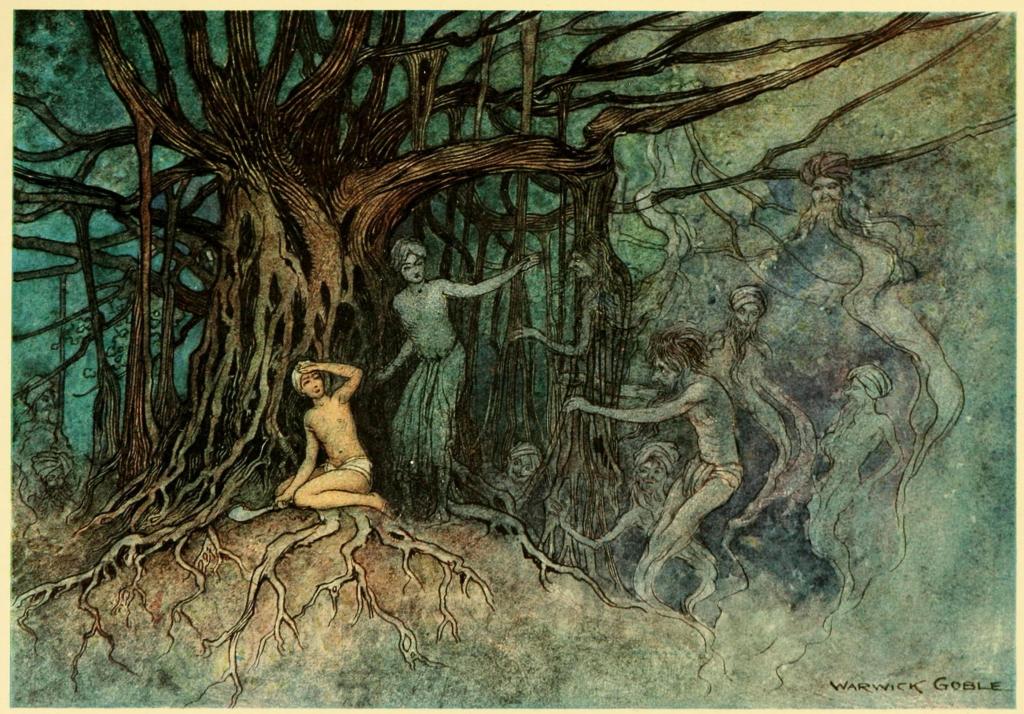
So, when it was told that we have a “Brahma Daitya”, a spiritually elevated Brahmin ghost who resides in one of the six betelnut trees standing like our forefathers lining the western wall of our two-storied house, I believed in him too.
We are not Brahmins. Rather we are actually one of those urban scheduled caste families who very much support the reservation policy of the government as that gives us access to admissions, rights to secure lower marks and yet place a rightful claim to government jobs and that too with some age relaxation. Well, my grandparents often categorically remind me, my sibling and my two cousins, sons of my paternal uncle, that we have historically faced so much inequality and oppression at the hands of the upper castes that we deserve some affirmative action to make it a level playing field.
But coming back to the Brahmin ghost, I was totally at a loss why he had chosen our house, much beneath his stature, to spend his afterlife. That’s the story I am going to share with you now, as told sometimes as a whole, sometimes in fragments by almost all the elders of our family and relatives who live in and away from our house.
It was a different time when Nawab Wajed Ali Shah had been exiled to Calcutta, now Kolkata. On the second week of January, a Brahmin came to my great great great grandfather’s door to seek refuge for the night. He was a holy man who had left his preferred dwelling in the caves of the Himalayas to bathe in the Sagar during the Makar Sankranti which was two days later.
As our elders would say, “Winters then were winters and not cursed by scientists who have changed the atmosphere and jeopardized the seasons”. It was pitiful, and fearful too, to see such a great man in such need. But my ancestral grandmother had to confess that we belonged to a much lower caste and were unworthy to treat him with hospitality. To this, the Brahmin had smiled and said, “Maybe I am the Narayana who has been sent to your house to cleanse it of all sins and sufferings. Do let me live in your God’s room (all houses were sure to have one such room allotted) and bring me just fruits and sweets with a glass of milk, if you can, for dinner. I don’t like to overeat at night. Give me two clean thick blankets, one to lie on and another to cover myself with. And please arrange some clean water in an earthen pot for me to drink. I am sure you won’t mind if I use the white marble glass in which you serve water to your gods.” Overjoyed by such easy solutions, the lady of the house was all too grateful to serve and oblige.
The following days were full of suppressed whispers about the Guest’s impact on our household. Some said the air of the house itself smelled of sacred chandan; others felt the whole atmosphere had become lighter and a positive energy seemed to swirl in the house. Every soul living in the house believed that the Himalayan Brahmin was a reincarnation of Shiva or Narayana Himself who had come to bless our family with fortune and prosperity.
As luck would have it, the Brahmin felt feverish in the morning and had to stay back the next two days. He couldn’t fulfill his wish of bathing in the Ganga Sagar on Makar Sankranti. Rather he stayed with our family who took care of him and he kept on uttering blessings for a wonderful future of the children and peaceful afterlife for the elders.
An idea struck my great great great grandfather. He prayed with folded hands to the Brahmin to stay back at our home and fulfil his purpose the next year and only then think of returning to the icy cave of the Himalayas. As other members of the family kept on insisting repeatedly the Brahmin had to accede.
A temporary single cot made from special mahogany wood was placed for him in the room for the gods. A special earthen oven was made in the courtyard and new utensils were bought too. New beddings and arrangement for evening meetings of the hoi polloi with the sacred man to hear him chant and advise had completed the deal. Of course, the evening meetings entailed collection of “dakshina” (holy payment) hoarded in more than one package.
By the time the next Makar Sankranti arrived, the Brahmin was well settled in our house. His health and complexion too had improved with all the “seva” (service) he received. Naturally, his treasury of “dakshina” had gained good weight too. And my great great great grandmother had been heard to say more than often, “What will this sacred person do with all this useless hoarding? He will obviously leave it for us…. But, no, no. We will definitely give him a portion as travel expenses. It’s not easy to walk all this way!” Some naughty members of the family and a rare few servants of the house were found to laugh secretly or smirk at such observations.
As the month of Poush came and the Brahmin showed no signs of leaving, the household now became uneasy with silent conjectures and assumptions. Ruling out all other possibilities, my great great great grandfather breathed his last a week before the Sankranti. Naturally, the sacred man couldn’t leave the bereaved family. Rather, he became the main priest in conducting the last rites. This doubled his wealth. After the stipulated period of grieving for fifteen days ended with the final “shraddha” (last rite puja), the Brahmin declared that he would observe “ekadashi” (Hindu religious day that occurs twice every Hindu month) for safety and welfare of the family. This would continue for a whole year till the “Batsarik shraddha” (yearly last rite puja) was done next year. Then he would be free to go ahead with his mission of bathing in the Sagar.
One year gave way to the next. Marriages, special pujas, deaths, births – something or the other held him back every year. Ultimately, he gave up the idea of Moksha (salvation) that came with that single dip in the Sagar and lived as an important elder in the family.
But no matter how holy and nourished, a man has to die. So, it was after eleven years, one stormy Saturday night, this Brahmin breathed his last in our puja room from natural asphyxia in his sleep. In the morning, he was found with rigor mortis quite set in.
Our family was in a fix. We were not supposed to cremate him and we knew no one related to him. The elders of the neighbourhood decided that since he was a sannyasi before he took refuge in our house, he was above all rituals. Thus, they would pay a contractual brahmin boy who would complete the rituals and be paid to observe the one-year grieving and the batsarik ritual next year. That would complete it all.
As decided, the expenses were to be taken from his savings only because no one else was entitled to pay for his rites. Now something happened that was extremely uncanny. Except a few annas nothing was found with his so-called belongings. The contractual brahmin saw the case go wrong and agreed just to cremate his body with no entailments of duties afterward. He declared that since the man had renounced family life much before his death, cremation should end any rituals usually attached with it. That would be the right way to show respect to his renouncement. Things ended thus.
The ritualistic elders and priests disappeared in no time leaving my ancestors to do whatever they wanted. And they wanted nothing more than to simply end all this ruckus and start looking for the lost wealth.
Decades passed. No one found anything of the lost treasure. Eventually everyone forgot about the loss and life went on.
It was during one night when a revolutionary friend of my grandfather came to seek refuge for a night that he reported seeing someone enter the then much changed puja room through the closed door miraculously like a shadow. Laughing at this ridiculous account, my then young grandfather went to see if anything was wrong. There were no electric lights in the puja room then. He carried a lantern.
Then a scream, a loud thud and fire spreading along the spilled oil on the floor!
After my grandfather was rescued from being burnt, brought to his bedroom and left with his young wife, he confided in her that a shadow was moving in the puja room as if looking for something. He had thought it was a thief and jumped from behind only to land on the floor. He clearly saw the man-shadow looking angrily at him as he floated out of the puja room through the window.
After this incident, many in our family reported to seeing a shadow on our rooftop, in our garden, on our bigger trees and so on. The gardener confidently rebuked my grandfather for not believing him as he was innocent of destroying the seasonal flower quarry on the western stretch beneath the betelnut trees year after year. No flower grew there properly as the soil would always be trampled and dug out.
Ultimately it was deduced that the spirit of the Brahmin who had died alone and had got no rituals except the cremation was looking for his lost wealth for decades and living on the betelnut trees to avoid attention. His soul must be vexed and only a “pinda dan” (offering last water and food from earth) can provide him freedom. To save the household from any further ill-effects, the ritual of “pinda dan” was performed following all the proper rules.
It is January now, Poush in Bengali calendar. Makar Sankranti is just a few days away. On a Saturday evening, we were celebrating my grandmother’s eightieth birthday party at our house. We, the children of the house, were playing hide and seek when suddenly one of my cousins who had gone to hide on the roof gave a shrill cry and ran down madly as if he had seen a ghost! Oh yes, this is exactly what he claimed! A man-shadow was looking down from the cornice at the party and as my cousin rushed through the door, he seemed to turn at him angrily but he had no eyes! Again, he floated away to the betelnut tree on the farthest western corner. My cousin insisted that the shadow really had no eyes, yet he could feel its angry look upon him.
Featured Image: “Brahma Daitya” illustrated by Warwick Goble in Lal Behari Dey’s Folktales of Bengal (1912)
Author Bio


Spriha Bose is pursuing her undergraduate education with English Major from Calcutta University and with DELF B2 certificate for proficiency in French.
She is a keen observer of life as it goes by or stops at a junction. A passionate reader of all types of literature, she loves to observe the different identities and intricacies of human relationships with the society and also with their own selves. To be in the shoes of others and narrate their points of view is a challenging job that she wants to continue in her future writings too.
She writes advertorials online, delving into analytical thoughts to connect with all in simple yet evocative language.